
Tata Beach Swim
- Jan 4, 2026
- Last edition date
- Distances: 600m and 1.2km
At a glance
- Last edition date
- January 4, 2026
- Distances
- 600 m · 1.2 km
- Where
- Sea · Tata Beach, Golden Bay, New Zealand
About the race
The Tata Beach Swim, held in the sea at Tata Beach in Golden Bay, New Zealand, offers two distinct open water options along the bay. A 600-meter course is designed specifically to welcome first-time ocean swimmers into calm saltwater, while a 1.2-kilometer event steps up the distance for anyone eager to stretch out into a steady, uninterrupted sea rhythm. Entering the water from the golden sand, both distances allow swimmers to focus entirely on their stroke without fighting heavy ocean swell. Held in early January during the high South Island summer, the swim often meets smooth, glassy sea conditions that draw crowds of supporters along the sand. In past editions, over a hundred swimmers and spectators have gathered on the shoreline even when overcast weather rolled across the headlands. During one rainy edition, Paralympic champion Dame Sophie Pascoe noted that the damp weather made for a surprisingly pleasant swim, while participants pointed out that once your body adjusts to the water, the falling rain simply disappears.
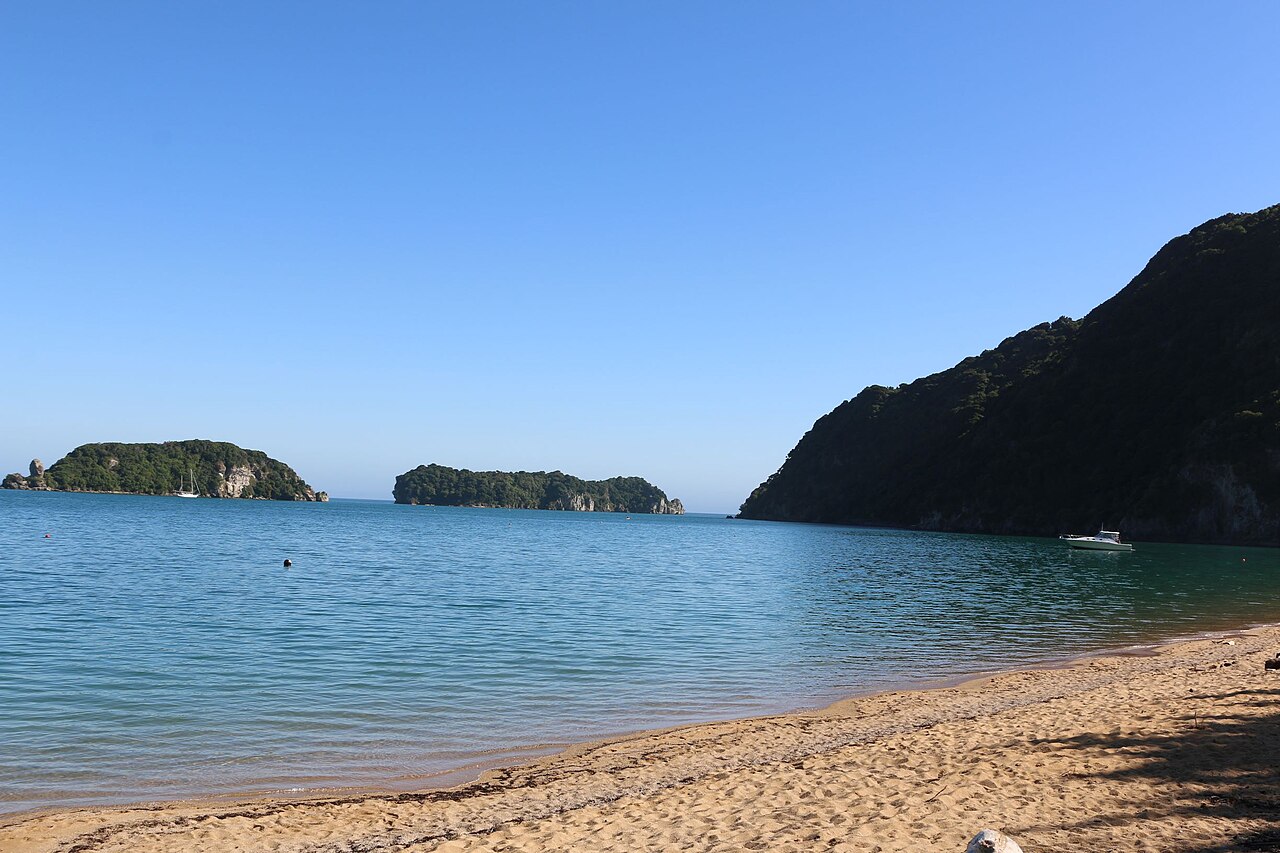
Tata Beach and Tata Islands: all-tide swimming and sea stacks
Unlike many neighboring beaches in Golden Bay where the sea recedes hundreds of meters, Tata Beach is accessible and fully swimmable at every stage of the tide. This reliability makes the bay a favored local haunt for water-skiing, sea kayaking, and distance swimming, looking straight out toward the Tata Islands located just one kilometer offshore. These rugged limestone outcrops sit within Abel Tasman National Park. The southern island, Ngawhiti, is crowned at its southern end by an imposing limestone sea stack that rises straight from the water. Because of their sheer topography and deep surrounding channels, the islands historically served as the only reliable deep-water shelter for large sailing vessels caught in Golden Bay.
Below the surface, the waters encompassing the islands provide a rich marine nursery for young fish. Above the tide line, the limestone ledges host one of the largest breeding colonies of spotted shags in New Zealand. Humans have long recognized the shelter of this coast, with archaeological evidence on Ngawhiti revealing pre-European Māori settlement where native vegetation was cleared for coastal cultivation.
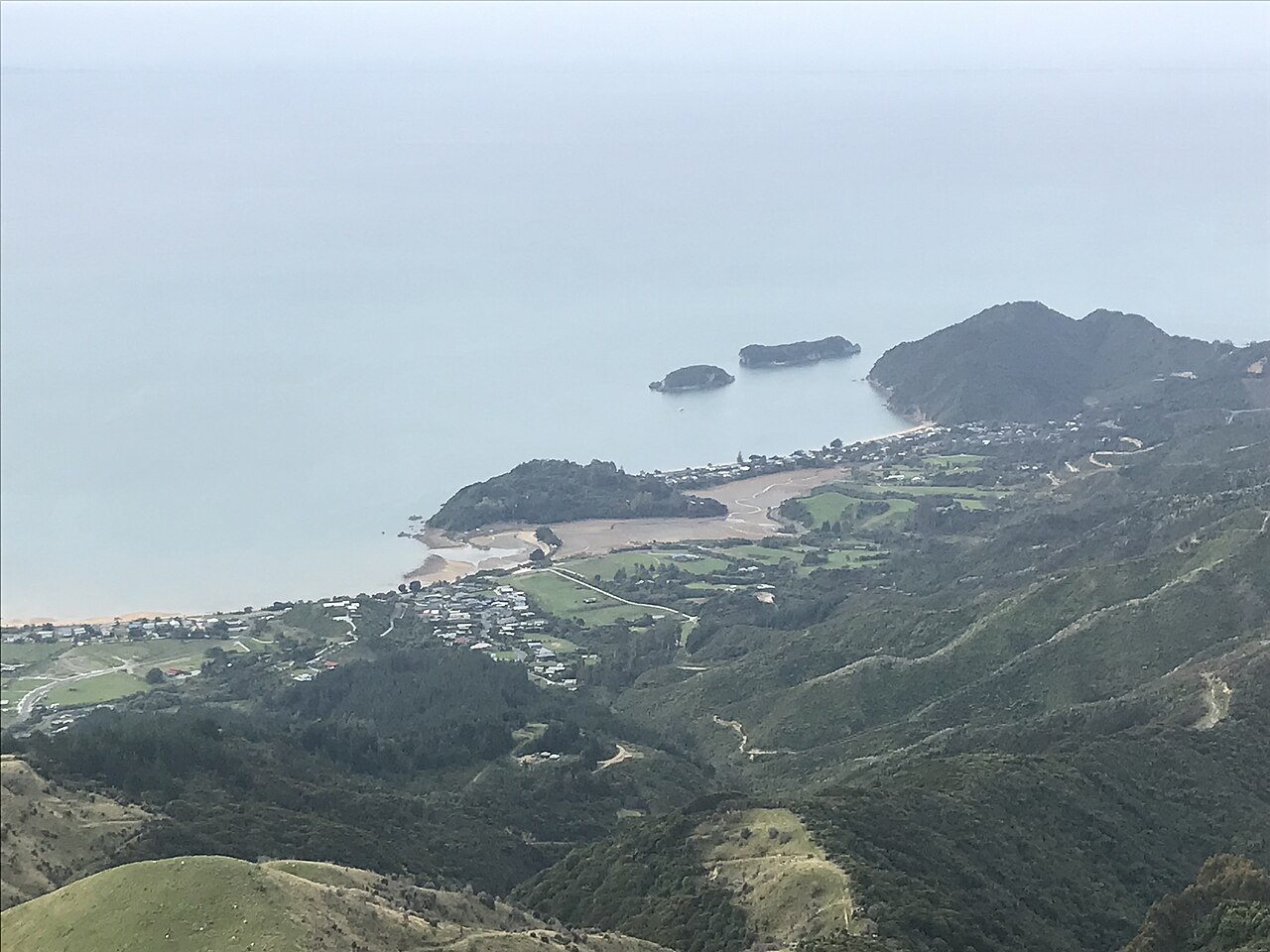
Taupō Point and Wainui Bay: Abel Tasman and Māori pā
Just down the coast to the east lies Wainui Bay, where the Wainui River empties across expansive sand flats. The Māori name Wainui evokes the dramatic tidal movement that leaves vast expanses of the bay entirely dry at low tide. When the sea withdraws, walkers can cross the entire Wainui Inlet on foot within a two-hour window before the ocean surges back into the estuary. Guarding the mouth of the bay, Taupō Point rises as a 49-meter limestone bluff tied to the mainland by a narrow sandy spit. Along this elevated ridge, archaeologists have uncovered the defensive earthworks of a seventeenth-century Māori pā, preserving trenches and traditional cooking pits overlooking the bay.
On December 18, 1642, Abel Tasman dropped anchor in neighboring Whariwharangi Bay near Taupō Point, where the first recorded encounter between Māori and Europeans ended in conflict and the death of several Dutch sailors. Further along the cliffs at Uarau Point, ancient sea caves pierce the limestone in an area famous for natural sinkholes and subterranean rumbles, remembered in Māori tradition as the lair of the mythical goblin Ngārara-huarau.
Wainui Falls and Te Waikoropupū Springs: freshwater plunges
For a freshwater dip after racing in the sea, the Wainui River carves through a narrow granite gorge tucked directly behind the bay. An easy walking track crosses a high suspension bridge hung over granite boulders and flood-deposited logs to reach Wainui Falls. Here, the river plunges twenty meters over bedrock into a deep, shaded basin that serves as a popular summer swimming hole. Local lore holds that the severed tail of the monster Ngārara Huarau was thrown into this pool, with distinctive reddish-brown mineral stains on the rocks downstream explained as the blood of the taniwha. The native forest shading the trail is also home to rare giant carnivorous land snails of the genus Powelliphanta.
Further inland across the valley, the Te Waikoropupū Springs form the largest cold-water spring system in the Southern Hemisphere. Fed by an immense aquifer system spanning 940 square kilometers and reaching mountain peaks at 1,650 meters, the springs discharge an average of over thirteen cubic meters of water per second through eight main vents. The water bubbles to the surface at an unvarying temperature of 11.7 degrees Celsius. On the sandy bed of the spring basin, smaller vents continuously blast white sand upward in mesmerizing, dancing cones beneath the crystal-clear surface. Māori tradition reveres this spring as the sacred ancestral realm of Huriawa, a female taniwha.
Awaroa Inlet and Tōtaranui: granite sands of Abel Tasman
Further along the park coastline, Tōtaranui unrolls as a pristine one-kilometer curve of sand accessible by foot or scheduled water taxis. The beach owes its bright golden color to weathered orthoclase feldspar crystals embedded in the native coastal granite. Once a remote farming settlement before Abel Tasman National Park was established in 1942, Tōtaranui now serves as the gateway to the remote coastal tracks. Just beyond lies the Tonga Island Marine Reserve, established in 1993 to protect the marine ecosystem surrounding the granite headlands of Awaroa Inlet. Awaroa Beach traces an 800-meter crescent of fine gold sand at the edge of another tidal estuary, where hikers must wait for a two-hour window around low tide to ford the shallow channels on foot.
Out on the exposed tidal flats rests the wooden skeleton of the scow Venture, a former coastal trading vessel preserved in the tidal sands. Nearby, the restored wetlands of Hadfield Clearing offer peaceful nesting grounds for shy fernbirds and rare pāteke ducks, rounding out an ocean swimming journey along the tranquil edges of Golden Bay.
Sources: Tōtaranui · Wainui River (Tasman) · Tata Islands · Wainui Falls · Wainui Bay · Ligar Bay · Tata Beach
Course
A simple and accessible course designed for first-time ocean swimmers or those looking for a relaxed summer dip in the bay.
A slightly longer course ideal for swimmers wanting to settle into a rhythm and enjoy the calm conditions of the bay.
How to get there
Tata Beach Swim
Frequently asked questions
- When was the last edition of Tata Beach Swim?
- The last edition of Tata Beach Swim took place on January 4, 2026.
- What distances does Tata Beach Swim offer?
- Tata Beach Swim offers 600 m and 1.2 km.
- Where does Tata Beach Swim take place?
- Tata Beach Swim is a sea swim. Location: Tata Beach, Golden Bay, New Zealand.
Where to stay
Accommodations in Tata Beach are predominantly low-key, reflecting the area's relaxed pace. You will find options ranging from modest self-contained beach cottages and classic Kiwi holiday homes to quiet camping and cabin sites located just steps from the sand. Most properties are family-run and range from $150 to $350 per night during the peak summer period. It is advisable to book well in advance for the January event, as the area's limited capacity fills rapidly with summer holidaymakers.
Things to do nearby
Beyond the race, the Golden Bay area is best explored at a slower pace. The region offers exceptional kayak and SUP rentals to navigate the sheltered coves near the islands, while the nearby native forests provide short, accessible trails to waterfalls like Wainui. For a taste of the local culture, visit the small arts-and-crafts galleries in the surrounding villages or sample local produce at the artisan markets that congregate in the valley throughout the summer season.
Swimmers
Other races by this organiser
- Opening SplashNelson, NZ
- Rylock ChallengeNelson, NZ
Similar races


Comments
Transparency: some links on this page (stays, flights, experiences, gear) are affiliate links — if you book or buy through them, Omniathlon may earn a commission from the partner at no extra cost to you. As an Amazon Associate we earn from qualifying purchases.