
Swim GP Mykonos
- Oct 3, 2026
- Last edition date
- Distances from 200m to 10km
At a glance
- Last edition date
- October 3, 2026
- Distances
- 200 m · 400 m · 2 km · 5 km · 10 km
- Where
- Sea · Mykonos, South Aegean, Greece
- Entry fee
- 105 €
- Registration
- swimgp.com
About the race
On the Aegean coastline of Mykonos, Swim GP Mykonos brings open water competition to the southern shores of the Cyclades. Organized by Swim Grand Prix in collaboration with the Municipality of Mykonos, this open water swimming race introduces an international racing circuit to the blue sea of the South Aegean. Swimmers assemble at Elia Beach, selected for its international profile and clear maritime setting. The competition offers a broad spectrum of distances that caters to sprinters, middle-distance swimmers, and long-distance marathoners. Participants can select courses over 200, 400, 2,000, 5,000, and 10,000 metres. For the premier 10-kilometre challenge, competitors are required to complete two full 5-kilometre laps in a clockwise direction across the bay before swimming back ashore to cross the finish line on the sand of Elia Beach.
Entering the sea from the beach, swimmers find their stroke in clear saline water and navigate between offshore turning marks under open skies. The events are scheduled across seasonal swimming windows, with autumn racing in October and late-spring dates in May. Safety protocol across all distances is closely regulated on the open water course. Every athlete must swim equipped with a personal safety buoy throughout the race. Towed smoothly behind the swimmer on a waist belt, the high-visibility buoy floats clear of the stroke while ensuring continuous tracking. It provides an immediate visual point of contact for safety vessels and allows swimmers to focus entirely on their pace and rhythm through the salt water.
Elia Beach and the meltemi
Elia is the longest sandy beach of Mykonos, fully organized, with taverns, bars and water sports facilities such as water-skiing, parasailing and windsurfing. Elia Beach runs for roughly 700 meters or more along a broad, south-facing bay on the southeastern coast of Mykonos. Because the bay of Elia faces generally south, it is somewhat sheltered from the strong summer meltemi winds that whip up chop on the north coast of Mykonos, and its water is clear and usually calm. The meltemi, the strong, dry north wind of the Aegean Sea, blows periodically from about mid-May to mid-September. Etesian winds in the Aegean are strongest in the afternoon and often die down at night, though sometimes they last for days without a break.
Rineia and the Revmatiaris islets across the strait
In 530 BC, Polycrates of Samos conquered Rineia, the island lying west of Delos across a narrow strait, and ceremonially dedicated the entire landmass to the sacred sanctuary of Apollo on Delos. The maritime expanse around the island soon became woven into the classical history of the central Aegean archipelago. During the Peloponnesian War, the Athenians established strict ritual purity laws on Delos. To enforce this purification, Rineia was transformed into a vast necropolis where the dead from Delos were brought for burial across the water. A dedicated sanatorium was also constructed on the island to care for the terminally ill who were expelled from Delos under Athenian decrees. Today, the long shoreline of Rineia stands silent, preserving the archaeological footprint of those ancient maritime crossings.
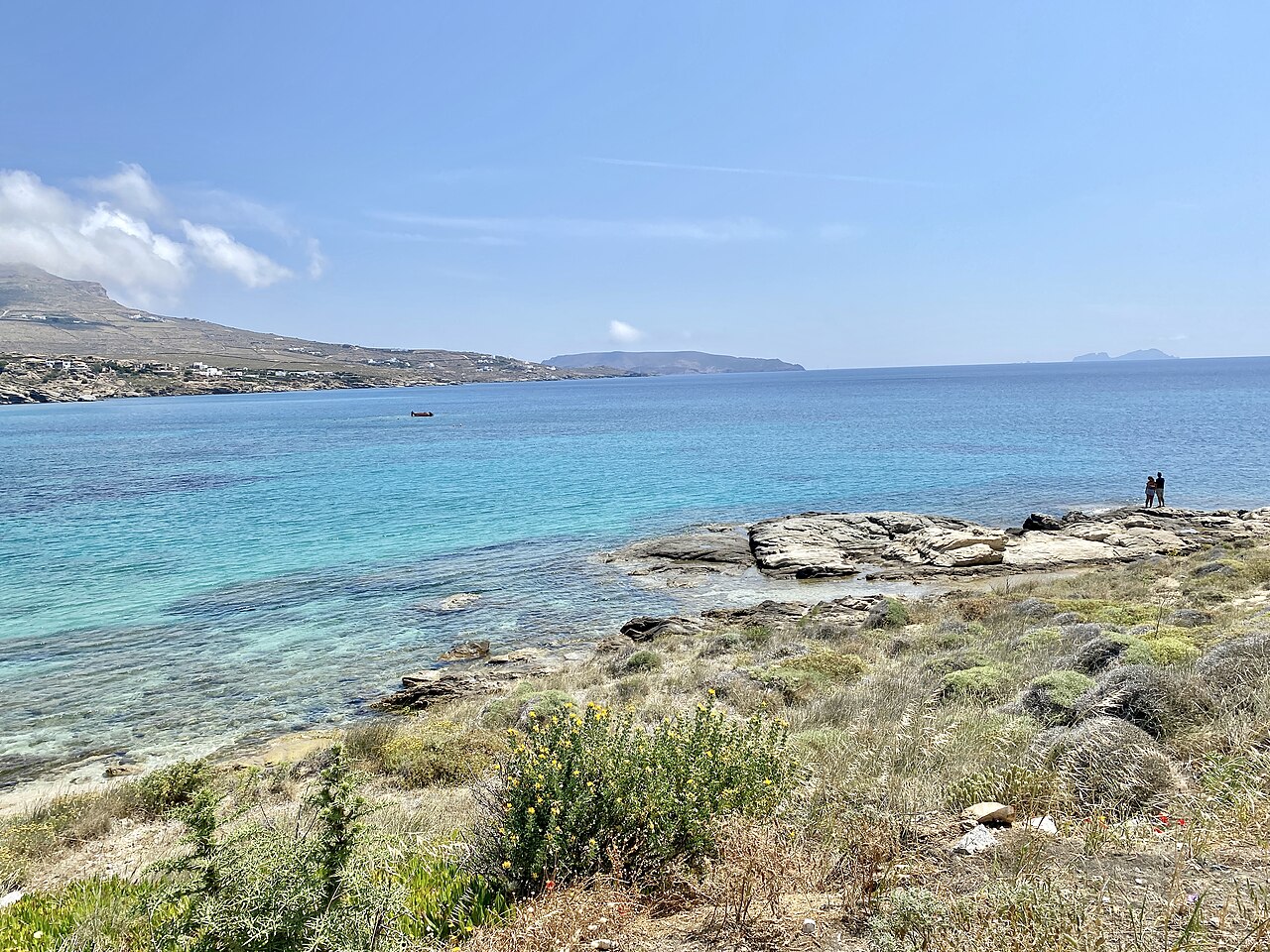
Between the shores of Delos and Rineia sit the rocky islets of Mikros Revmatiaris and Megalos Revmatiaris, separated only by a narrow channel of sea. The names of both islets derive directly from the strong marine currents that flow through this strait. Megalos Revmatiaris preserves significant archaeological remains, including the ruins of an ancient temple dedicated to the goddess Hecate and an early Christian three-aisled basilica. Today, both islets are designated as protected archaeological sites and preserved natural habitats incorporated into the European Natura 2000 network. Across the wider maritime corridor toward southeastern Tinos, the sea links to coastal bays such as Ormos Agiou Ioannou and the settlement of Lychnaftia. In that southeastern sector of Tinos, Laouti beach lies between Agios Sostis and Ormos Agiou Ioanni, fronting shallow waters and a sandy seabed.
The harbor of Chora and maritime Little Venice
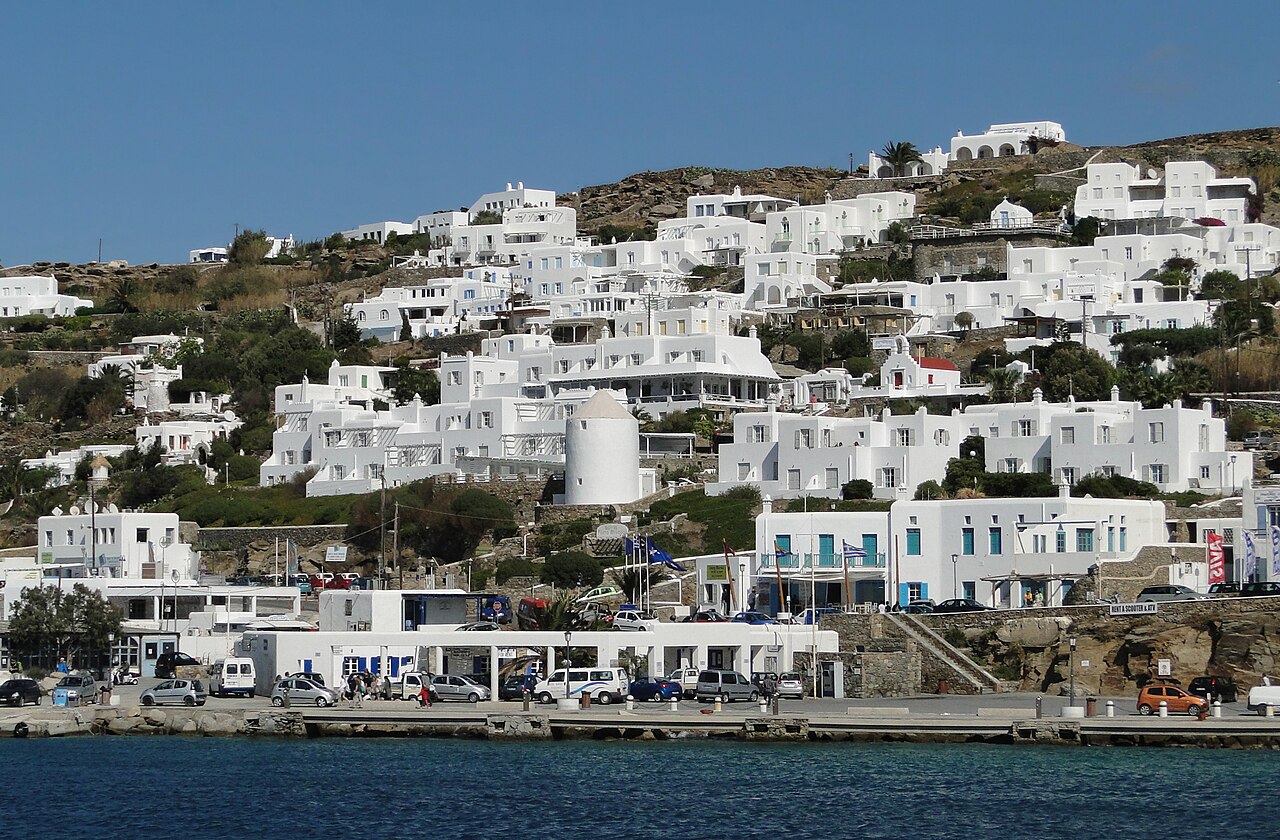
High above the harbor, the famous windmills of Chora were constructed by the Venetians during the sixteenth century to harness the island's unrelenting winds for milling grain into flour. Directly along the edge of the harbor basin, the eighteenth-century waterfront quarter known as Little Venice was built facing the salt spray. Constructed in the mid-1700s, these historic fishermen's houses feature distinctive basement doors opening directly onto the sea surface. These openings allowed crews to row directly to their thresholds. Nearby, adjacent to the new harbor of Mykonos at Tourlos, the sandy cove of Agios Stefanos provides a sheltered beach right beside the maritime approaches. Drinking water was historically drawn from coastal wells such as Tria Pigadia, constructed in Chora in 1722.
These wells reach depths of only 5 to 6 metres because they were excavated directly into the coastal sand to intercept groundwater. In modern times, the island relies directly on the sea for its freshwater needs, generating 4,500 cubic metres of potable water every day through reverse osmosis of seawater. The harbor has also seen military naval history: in June 1794, a naval battle broke out directly inside the main port of Mykonos between opposing British and French warships.
The sheltered coves of the southern coastline
On the southwestern edge of Mykonos, the beach of Psarrou is distinguished by its sheltered geographical position and its sandy shoreline. Further along the southern coast lies the bay of Platis Gialos. Platis Gialos features a broad, sweeping beach of golden sand that fronts the clear Aegean water. In the southwestern corner of the island, the coastal settlement of Ornos sits nestled at the innermost point of Korfos Bay. Historically, this sheltered inlet functioned as an active fishing port for the island, providing a safe haven for local boats. From the coast, the inland community of Ano Mera administers several peripheral landforms, including the offshore islets of Ktapodia and Dragonisi.
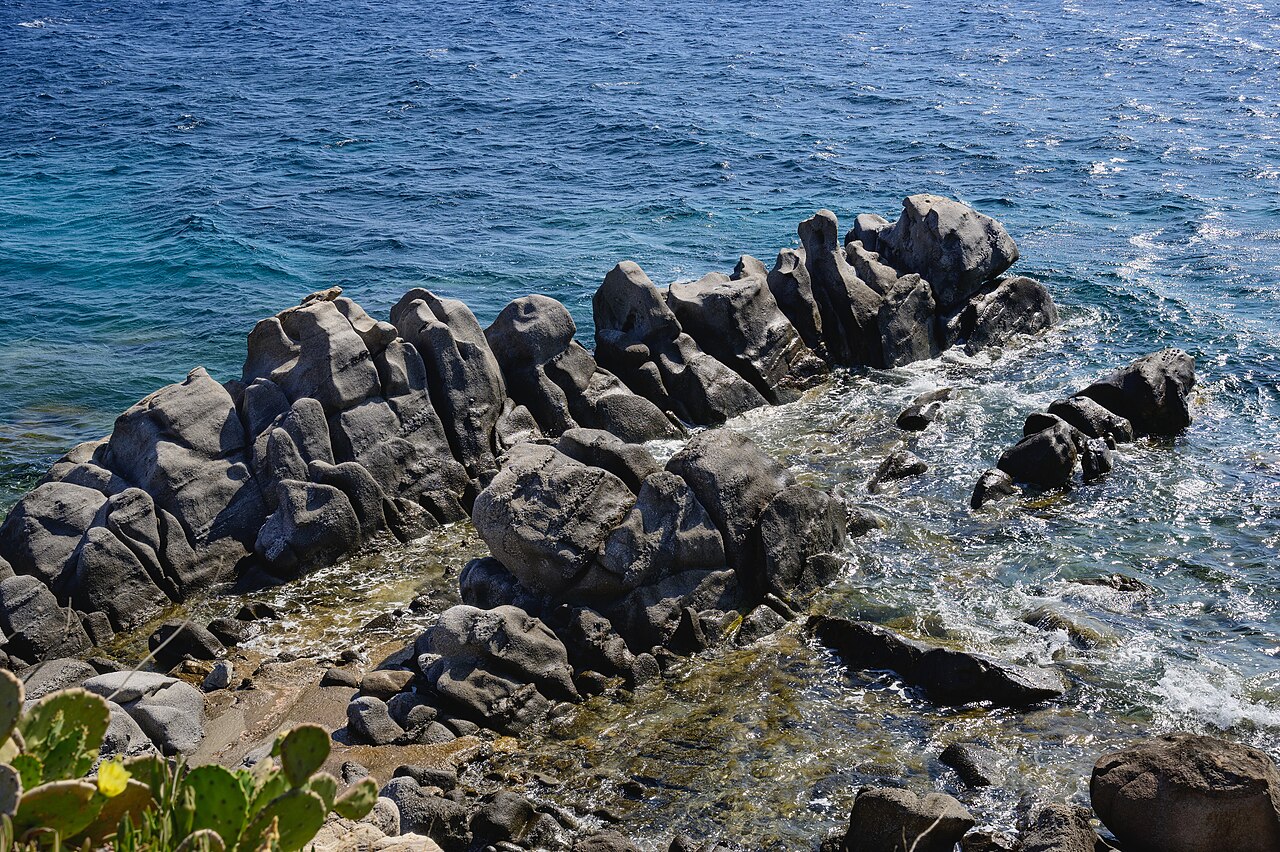
On the eastern coast of Mykonos, Kalafati beach faces strong prevailing winds, making it a well-known destination for windsurfers rather than competitive swimmers. Along the northern perimeter, the small uninhabited rock island of Marmaronisi sits exposed at the entrance to Panormos Bay. Marmaronisi is composed of rock suitable for the production of lime. Elia Beach remains the focal point for open water swimmers racing through the South Aegean.
Course
How to get there
Swim GP Mykonos
Frequently asked questions
- When was the last edition of Swim GP Mykonos?
- The last edition of Swim GP Mykonos took place on October 3, 2026.
- What distances does Swim GP Mykonos offer?
- Swim GP Mykonos offers 200 m, 400 m, 2 km, 5 km, and 10 km.
- How much is the entry fee for Swim GP Mykonos?
- The entry fee is 105 €.
- Where does Swim GP Mykonos take place?
- Swim GP Mykonos is a sea swim. Location: Mykonos, South Aegean, Greece.
- How do I register for Swim GP Mykonos?
- The reference page for registering for Swim GP Mykonos is https://swimgp.com/.
Where to stay
Mykonos offers a range of options, from traditional Cycladic whitewashed villas to boutique hotels overlooking the harbor. During the race weekend, staying near the Old Port provides the most convenient access to the event village and start lines. Expect to find a high density of mid-range to luxury accommodations; double rooms typically range from €180 to €450 per night, depending on proximity to the water and the specific level of service.
Things to do nearby
Beyond the race, the island provides a deep dive into Aegean history and leisure. Swimmers can explore the archaeological site of Delos, accessible by short boat trips, or engage in sea-kayaking along the less-frequented southern coves to recover. Local culinary experiences focus on traditional Cycladic recipes, often featuring fresh seafood and local cheeses, providing a recovery-focused menu that reflects the island's maritime heritage.
Swimmers
Other races by this organiser
- Swim GP - Travessia Oeiras-CascaisCascais, PT
Similar races


Comments
Transparency: some links on this page (stays, flights, experiences, gear) are affiliate links — if you book or buy through them, Omniathlon may earn a commission from the partner at no extra cost to you. As an Amazon Associate we earn from qualifying purchases.