
Ocean Swim Series - RotoVegas
- Distances from 100m to 3.5km
At a glance
- Distances
- 100 m · 200 m · 500 m · 1 km · 1.5 km · 2 km · 2.5 km · 3.5 km
- Where
- Lake · Lake Tikitapu (Blue Lake), Rotorua, Bay of Plenty, New Zealand
- Entry fee
- 500 m: 75 NZD · 1.5 km: 85 NZD · 2.5 km: 119 NZD · 3.5 km: 124 NZD
- Registration
- oceanswim.co.nz
About the race
Lake Tikitapu sits cradled inside an ancient volcanic crater just outside Rotorua, its bed of pale pumice and rhyolite scattering sunlight into an intense turquoise blue. This vivid setting is home to the Ocean Swim Series - RotoVegas, an open water swimming event held across the freshwater basin of Lake Tikitapu in the Bay of Plenty on New Zealand's North Island. The circular arena was formed roughly 15,635 years ago when a sequence of rhyolitic eruptions created a natural lava dam across the valley. The crater reaches a maximum depth of 27.5 metres. Under the surface, the bright pumice and volcanic stone lining the bed produce remarkable water clarity that gives swimmers a clear view of the deep blue below. Rainbow trout and brook trout navigate these cold, clear depths beneath the swimmer lanes. Surrounding the entire perimeter, a 5.5-kilometre walking track winds through native bush and stands of tall exotic conifers, tracing the rim of the sunken crater.
The RotoVegas events: distances, night swim, and the Amphibian
The race is staged by the New Zealand Ocean Swim Series, taking on Rotorua's affectionate local moniker 'RotoVegas', inspired by the nearby city's vibrant commercial strip and neon signs. The daytime schedule spans courses for different endurance levels, featuring 3.5km, 1.5km, and 500m events alongside 100m and 200m dashes for junior swimmers. For athletes who want to combine water and trail, the Amphibian event links the lake and the surrounding area into a single continuous test. The race starts with a 1.7-kilometre open water swim, transitions straight onto the forest paths for a 3.5-kilometre trail run under the canopy, and finishes with a final 500-metre sprint through the water to the shore.
Once dusk falls, the setting shifts entirely for the Swim the Night distance. Swimmers venture into the darkened lake equipped with mandatory illuminated personal tow floats that make every participant visible from afar. Across the water, the safety lights string together into a moving, luminous ribbon in the dark, giving swimmers the unique opportunity to pause, roll onto their backs, and gaze at the southern stars in the complete silence of the night. To safeguard this delicate freshwater ecosystem, every entrant must observe the strict 'Check Clean Dry' biosecurity procedure before stepping onto the beach. Thoroughly inspecting, washing, and drying wetsuits and gear stops the spread of the invasive freshwater clam, ensuring the lake's exceptional clarity and volcanic pumice bed remain pristine for seasons to come.
Mokoia Island and Lake Rotorua: Hinemoa's legendary swim
The lake's indigenous heritage is woven into its very name: Tikitapu commemorates a sacred greenstone necklace lost in the water by a high chief's daughter while she was bathing. Lake Rotorua is an expansive body of water covering nearly 80 square kilometres inside a massive volcanic caldera that collapsed 240,000 years ago. Averaging ten metres in depth, it forms the cultural and geographic anchor of the seventeen Lakes of Rotorua. In the heart of Lake Rotorua stands Mokoia Island, an imposing rhyolite lava dome extruded upward after the caldera floor collapsed. Rising 180 metres above the lake's surface, the steep volcanic dome is rimmed by natural geothermal pools along its foreshores.
The island is famous as the setting of one of New Zealand's greatest open water swimming legends: the crossing of Hinemoa. The young woman swum 3.2 kilometres across the open expanse of Lake Rotorua to reach her lover Tutanekai, using dried gourds as flotation gear to keep herself buoyant. Today, Mokoia Island serves as a protected sanctuary for rare native birds, providing a safe haven for North Island brown kiwi, North Island kōkako, and endangered North Island saddlebacks.
Rotorua lakefront and the historic thermal bathhouses
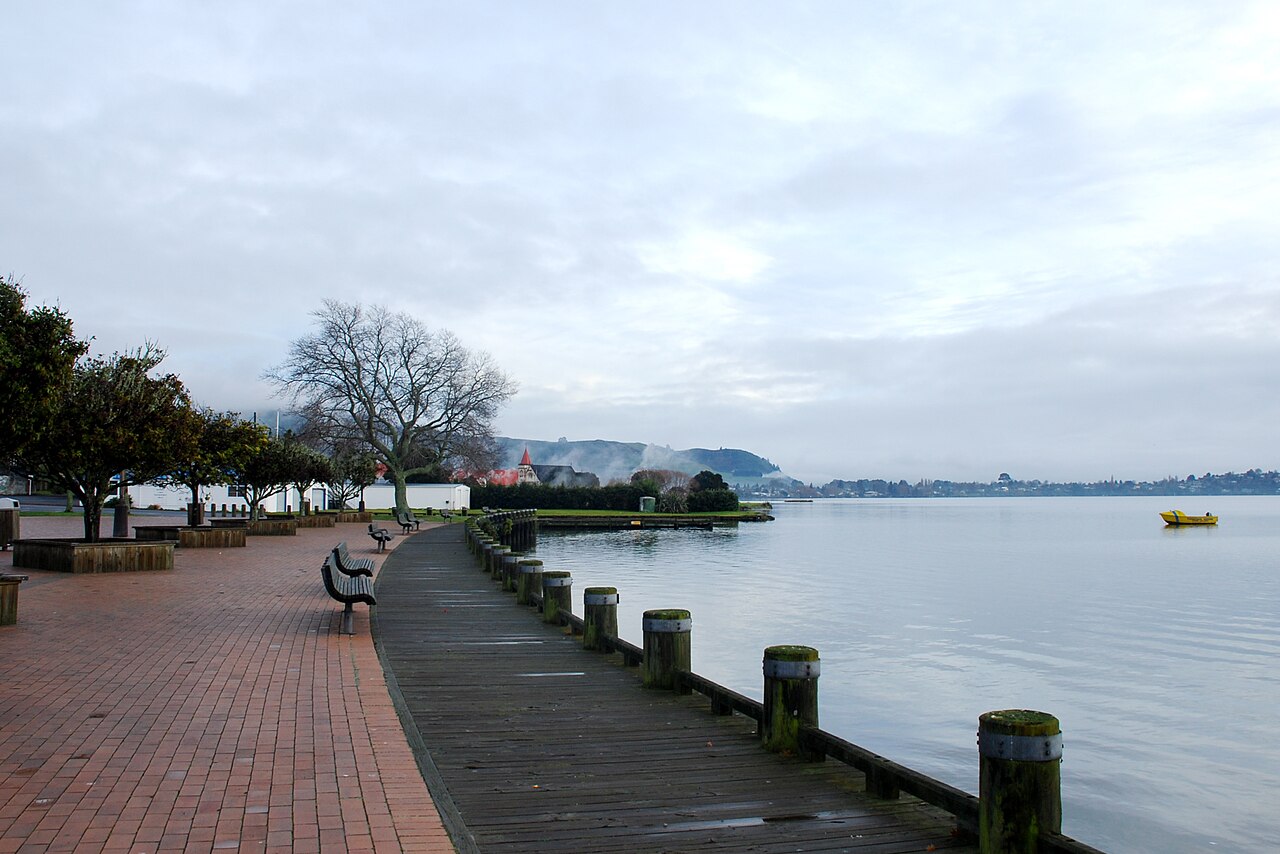
In sharp contrast to the crystal turquoise of Tikitapu, the water of Lake Rotorua carries a distinct yellowish-green hue, tinted by intense geothermal vents and high sulphur concentrations. Lakebed surveys have discovered thousands of circular pockmarks carved by underwater gas vents, alongside an ancient submerged river running across the floor. Bathing along this geothermal lakefront has a centuries-old pedigree, beginning with local Māori who soaked in the acidic mineral waters of Te Pupunitanga. European thermal bathing started here in 1878 when Father Mahoney dug out rudimentary shoreline pools, leading directly to the opening of the Pavilion Bath House in 1882 on the site now known as the Polynesian Spa. Over the decades, the mineral pools attracted international figures, including the Duchess of Cornwall and York, who gave her name to the Duchess Bath in 1901, and Prime Minister Sir Joseph Ward, whose regular visits inspired the Ward Baths.
In 1902, Mary MacKillop made the journey to the lake shore to bathe in the mineral pools of the Duchess Bath to treat rheumatism in her knees. Steps away in the Government Gardens, visitors can view the Blue Baths, an architectural landmark that gained renown in the 1930s for sanctioning mixed-sex swimming in thermal water. The caldera waters also preserve a colorful maritime heritage, having witnessed both the sinking and salvage of the 80-foot steamship Hamurana in the early 1900s and the cruises of the Lakeland Queen, a classic sternwheeler paddle vessel operating on the lake since 1986. From the volcanic pumice shallows of Tikitapu to the legendary crossings of Rotorua's caldera, this region offers one of open water swimming's most distinctive landscapes.
Sources: Rotorua · Lake Tikitapu · Te Papaiouru Marae · Government Gardens
Course
OceanKids course at Lake Tikitapu.
OceanKids course at Lake Tikitapu.
RotoVegas short-distance course at Lake Tikitapu.
RotoVegas mid-distance course at Lake Tikitapu.
Swim The Night course at Lake Tikitapu, performed at night with mandatory tow floats and lights.
Round the Lake course at Lake Tikitapu (Blue Lake).
Awards
Refer to Series Competition and Prizegiving pages on official website.
Previous editions
Useful info
Individual registrations for Rotorua open on May 31, 2026. Multi Passes for the entire series are available. Event part of the New Zealand Ocean Swim Series. Please consult the official website for wetsuit regulations and detailed logistics.
How to get there
Parking on the reserve areas at Lake Tikitapu is available; follow directions of event crew. Do not park down the drive near the toilet block (reserved for emergency/disability).
Ocean Swim Series - RotoVegas
Frequently asked questions
- What distances does Ocean Swim Series - RotoVegas offer?
- Ocean Swim Series - RotoVegas offers 100 m, 200 m, 500 m, 1 km, 1.5 km, 2 km, 2.5 km, and 3.5 km.
- How much is the entry fee for Ocean Swim Series - RotoVegas?
- Entry fees by distance: 500 m: 75 NZD · 1.5 km: 85 NZD · 2.5 km: 119 NZD · 3.5 km: 124 NZD. Te Arawa Lakes Trust beneficiaries receive 25% off entry. Prices in NZD.
- Where does Ocean Swim Series - RotoVegas take place?
- Ocean Swim Series - RotoVegas is a lake swim. Location: Lake Tikitapu (Blue Lake), Rotorua, Bay of Plenty, New Zealand.
- How do I register for Ocean Swim Series - RotoVegas?
- The reference page for registering for Ocean Swim Series - RotoVegas is https://www.oceanswim.co.nz/pages/banana-boat-legend-of-the-lake-rotorua.
Where to stay
Rotorua offers a diverse range of stays, from lakeside holiday parks and family-oriented camping sites to boutique lodges near the city center. Given the proximity to the Blue Lake, many participants opt for self-contained units or holiday homes which are plentiful in the area. Expect to pay between 150 and 350 NZD per night depending on the level of comfort and distance from the water. Early booking is recommended as the region is a year-round destination for both adventure sports and geothermal tourism.
Things to do nearby
The region is defined by its geothermal activity and Māori culture. Beyond the swim, you can explore the steaming vents and mud pools of Te Puia, or take a guided tour to understand the history of the nearby buried village of Te Wairoa. For those seeking active recovery, the area offers extensive mountain biking trails in the Whakarewarewa Forest, as well as kayak and stand-up paddleboarding opportunities on the surrounding lakes. Local markets and food experiences frequently feature traditional hāngī-style cooking.
Swimmers
What to see around
1. Te Puia (geysers and Maori culture). 2. Redwoods Treewalk (suspended path among giant redwoods). 3. Mountain biking in the Whakarewarewa Forest. 4. Polynesian Spa (natural thermal baths). 5. Zorb Rotorua (adrenaline activity in a rolling sphere).
Other races by this organiser
- Bean Rock SwimAuckland, NZ
- Legend of the LakeRotorua, NZ
- Swim the NightRotorua, NZ
- The Whanga SwimWhangamatā, NZ
- The Mount Ocean SwimMount Maunganui, NZ
Similar races


Comments
Transparency: some links on this page (stays, flights, experiences, gear) are affiliate links — if you book or buy through them, Omniathlon may earn a commission from the partner at no extra cost to you. As an Amazon Associate we earn from qualifying purchases.