
Messina Crossing
- Distance: 3.5km
At a glance
- Distances
- 3.5 km
- Where
- Sea · Strait of Messina, Messina, Sicilia, Italy
- Entry fee
- 230 €
- Registration
- siciliaopenwater.com
About the race
Across the blue expanse of the Strait of Messina, the Italian mainland looks close enough to touch. The Messina Crossing is an open water swim in the sea of the Strait of Messina, departing from the Sicilian coast at Messina and finishing across the water in Calabria. Rather than an aggressive timed race against competitors, the event is organized as a symbolic and communal sea crossing experience. The crossing covers a measured distance of 3,500 metres, providing an indicative span of 3.5 kilometres of open sea navigation. Organized by ASD Trirock in close collaboration with Le Traversate di Baia di Grotta, the journey delivers swimmers into one of the most storied maritime corridors on earth.
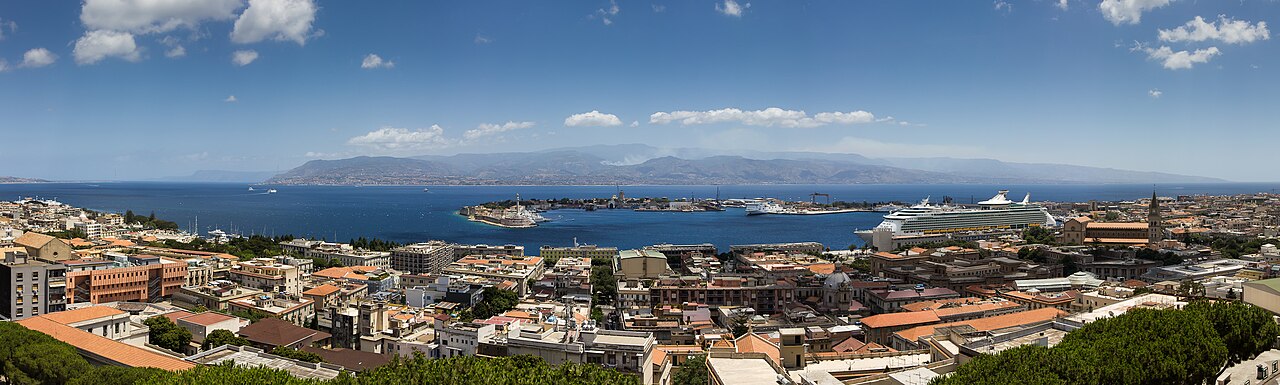
From Sicily, you set out in a direct heading toward the opposite mainland coast, and the crossing concludes officially the moment you reach and touch the first strip of Calabrian ground. Throughout the passage, every participant is accompanied by dedicated support boats that closely shadow the swimmers. Swimmers have reported a breathtaking atmosphere in which you test your resolve against the shifting currents of the strait. Past participants have encountered flat sea conditions where warm open waters are refreshed by sudden and invigorating cold streams, swimming without the disruption of jellyfish across the blue channel.
The Strait of Messina: tidal exchange, underwater canyon and the saddle
The strait connects the Tyrrhenian Sea to the north with the Ionian Sea to the south, narrowing down to a sea passage of just 3.14 kilometres. This geological bottleneck creates an alternating marine current system generated by distinct differences in water level and temperature between the two major marine basins. When these powerful opposing currents collide, they create vertical whirlpools that ancient lore personified as Scylla and Charybdis, accompanied by a large rotating vortex formed off the curved spit of Punta San Raineri. Beneath the swim path, the seafloor is defined by a shallow bathymetric saddle between Ganzirri and Punta Pezzo, where water depths sit between 80 and 120 metres.
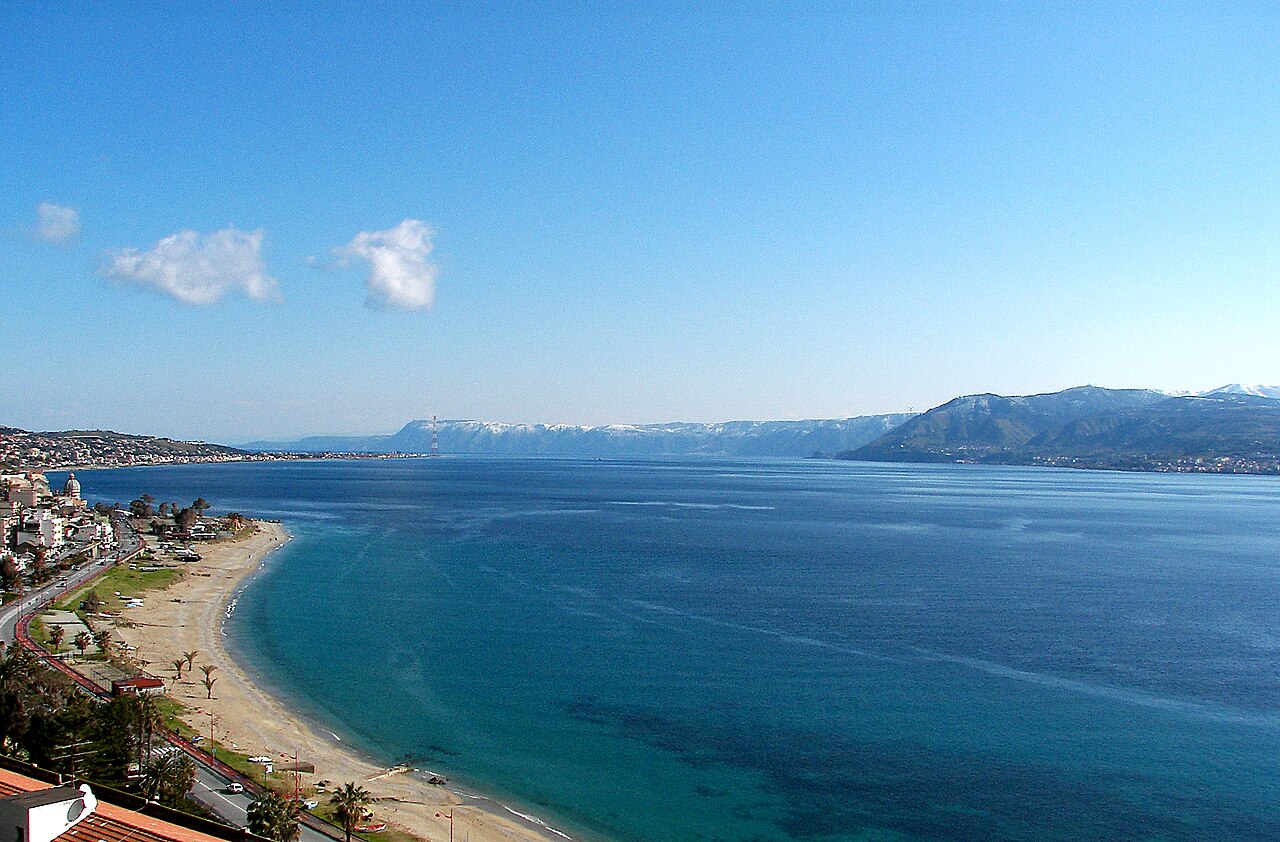
Beyond this underwater threshold, the seabed falls away into the dramatic Messina Canyon, a steep submarine abyss that begins past 500 metres deep and descends toward the Ionian abyssal plain. Upwelling forced over this high undersea saddle keeps summer surface water noticeably cooler by several degrees compared to the rest of the Tyrrhenian Sea. These vigorous currents constantly hyper-oxygenate the channel, fostering a diverse and exceptionally rich marine ecosystem beneath you. About six kilometres from the crossing area lies the ancient settlement of Messana, while the Strait of Messina was celebrated in Homer's Odyssey as the mythical lair of the sea monsters Scylla and Charybdis. The settlement was originally named Zancle, meaning sickle, because of the curving shape of the San Raineri sandspit that cradles its natural deepwater harbour.
Archaeological evidence reveals a Bronze Age village from between 3000 and 1100 BC that was already equipped with a natural landing site. The territory of the ancient city extended along the Tyrrhenian shore between Capo Peloro and Capo Milazzo, and reached down the Ionian coast as far as the Argenno Promontory. Traditional coastal hubs dedicated to fishing and farming developed at Myles, Nauloco, Elis, and Phoinix.
Capo Peloro: the sandy horn, coastal lakes and sentinel lighthouse
Capo Peloro is the low, sandy headland that marks the narrowest point of the strait between Sicily and Calabria. Formed and constantly reshaped by the rapid sea currents of the channel, this exposed point was venerated in classical antiquity as a dwelling place of the mythological Sirens. The original lighthouse structure was erected in 1853 and underwent a complete rebuild in 1884. A secondary light operates lower down at 22 metres above the sea, projecting a red flash every five seconds to assist navigation through the narrows. Tucked behind the coastal beaches of the cape, two small lakes have been famous since antiquity for their cockles and eels. Lago di Ganzirri rests just one metre above sea level across an area of 0.338 square kilometres. Alongside the neighbouring lake of Torre Faro, this basin is designated an ethno-anthropological treasure, preserving historic methods of telliniculture and mussel production.
Punta Pezzo: the ancient Cape Cenide on the Calabrian shore
Across the channel, swimmers direct their course toward Punta Pezzo, which forms the northernmost tip of the Calabrian side of the Strait of Messina. The coastline around this mainland point is subject to exceptionally strong currents. Severe winter storms continuously move the coastal sediments, causing the shape of the beaches to alter from one year to the next. Emerging onto this sandy point rewards the swimmer with the physical sensation of stepping straight onto the Italian peninsula after a continuous open water effort. Ancient writers Strabo and Pliny the Elder identified this precise Calabrian cape as ancient Capo Cenide. Classical geographers recorded sharply contrasting measurements for the channel crossing between the two headlands. Pliny the Elder documented the distance between Capo Cenide and Capo Peloro as 12 stadia, equivalent to roughly 2,212 metres. In contrast, Strabo wrote that the distance between the Sicilian cape and the Calabrian shore was merely six stadia.
Naval warfare in the strait: Carthaginian ambushes and Fatimid combat divers
The strategic position of the strait has drawn naval commanders into these waters across ancient centuries. Back in 425 BCE, Syracusan commanders and their allies stationed both land armies and an entire fleet at Pelorus. Decades later, in 396 BCE, the Carthaginian general Himilco took advantage of a strong north wind to move his warships rapidly from Pelorus to catch Messana by surprise. Carthage maintained a considerable strategic advantage in the strait during the conflict with regional adversaries. In 276 BC, during the Battle of the Strait of Messina, a Carthaginian naval squadron attacked King Pyrrhus of Epirus as his fleet attempted to cross the waterway. Pyrrhus sailed with an armada of 110 warships and hundreds of transport craft carrying his soldiers.
The Carthaginians sank 70 of the Greek warships and disabled another 28, leaving only 12 armed vessels and the troop transports to limp ashore at Locri. Military operations on these waters were repeatedly tested by the strait's unforgiving maritime conditions. About ten kilometres from the race area, an earlier invasion of Sicily planned by Octavian in 38 BC had to be completely aborted due to severe weather. Six years later, on September 3, 36 BC, the waters off the Sicilian coast witnessed the decisive naval Battle of Naulochus. Centuries later, the channel became an arena for innovative underwater warfare. Byzantine forces had landed at Messina in October 964, seizing the city and taking forts across the Val Demone.
In 965, the Byzantine fleet met the Fatimid Caliphate in a major naval clash across the Strait of Messina. During the engagement, Fatimid combat swimmers dived into the sea and lashed ropes to Byzantine steering rudders. Once immobilized, the Byzantine hulls were bombarded by Fatimid troops throwing ceramic jars packed with Greek fire onto their stern decks. Pushing through the deep blue waters of the Messina Crossing lets swimmers touch that same legendary sea, where currents, myth, and history converge stroke after stroke.
Sources: Stretto di Messina
Course
The crossing starts from the Sicilian coast near the Pilone area and proceeds towards the Calabrian coast. The route is dynamic, adjusted based on currents and maritime traffic, with athletes accompanied by individual support boats.
Awards
The event is described as a non-competitive, symbolic open water swimming experience.
Previous editions
Useful info
Non-competitive event. Competitive medical certificate (swimming/triathlon) and ASI membership (included) are mandatory. Wetsuit optional. Meeting point at Torre Faro (Messina). Mandatory pre-race technical briefing. Medical and rescue assistance included. Registration open until all spots are filled (max 30 per crossing).
How to get there
Reggio Calabria Airport (REG) at 15km (ferry included) or Catania (CTA) at 110km. Messina Centrale station is well connected. By car: A20 from Palermo or A18 from Catania. Parking: blue zones in the city center or interchange parking lots (e.g., Zaera) with shuttle services. Urban transport via tram and ATM buses.
Messina Crossing
Frequently asked questions
- What distances does Messina Crossing offer?
- Messina Crossing has a single distance: 3.5 km.
- How much is the entry fee for Messina Crossing?
- The entry fee is 230 €. Prices are per person. Deposit of 100 EUR required for booking. Additional boat for guests available for 90 EUR. Double crossing incurs extra cost (400-500 EUR).
- Where does Messina Crossing take place?
- Messina Crossing is a sea swim. Location: Strait of Messina, Messina, Sicilia, Italy.
- How do I register for Messina Crossing?
- The reference page for registering for Messina Crossing is https://siciliaopenwater.com/eventi/messina-crossing/.
Where to stay
Messina offers a mix of urban hospitality and coastal retreats. You will find boutique hotels located near the port area, perfect for early morning starts, alongside traditional 'case di pescatori' (fishermen's houses) renovated for tourism in the surrounding villages like Ganzirri. Budgeting around €80–€150 per night is standard for mid-range stays. For those wanting to be closer to the water's edge, camping facilities are available along the northern Sicilian coast, providing a more rustic, direct access to the sea and the race atmosphere.
Things to do nearby
The weekend in Messina blends maritime history with local culture. Beyond the swim, explore the archaeological layers of the city or take a trek up Mount Dinnammare for a panoramic view of the Strait and the Aeolian Islands. Gastronomy is a pillar of the visit; look for local tastings focusing on swordfish and traditional Sicilian street food. For active recovery, renting a kayak or SUP to explore the calm waters of the Ganzirri lakes—separated from the sea by the narrow strip of land—offers a peaceful contrast to the turbulence of the crossing.
Swimmers
What to see around
1. Pilone di Torre Faro (closest point to Calabria). 2. Ganzirri Lakes (nature reserve). 3. Messina Cathedral with the Astronomical Clock. 4. Excursion on the Peloritani Mountains for panoramic views. 5. Taormina and the Greek Theatre (50km away).
Other races by this organiser
- Egadi Ultra Swim | La Gran FondoFavignana, IT
- Il Giro dell'IsolaFavignana, IT
- Syracusae OpenwaterSiracusa, IT
- Avola OpenwaterAvola, IT
Similar races


Comments
Transparency: some links on this page (stays, flights, experiences, gear) are affiliate links — if you book or buy through them, Omniathlon may earn a commission from the partner at no extra cost to you. As an Amazon Associate we earn from qualifying purchases.