
Coupe de Noël
- Dec 20, 2026
- Distance: 100m
At a glance
- Next edition date
- December 20, 2026
- Distances
- 100 m
- Where
- Lake · Rade de Genève – Jardin Anglais, Genève, Switzerland
- Entry fee
- 40 CHF
- Registration
- coupedenoel.ch
About the race
The Coupe de Noël is an open water swimming race held in the cold waters of Lake Geneva along the Jardin Anglais promenade, in the heart of Geneva, Switzerland. Biscuit manufacturer René Doria founded the winter challenge in 1934, drawing inspiration from the historic Parisian race held across the Seine on Christmas Day. Today, organized by the Association Coupe de Noël, it stands as the oldest continuous sporting event in the Canton of Geneva and was officially inscribed on the Swiss Intangible Cultural Heritage list in 2023. The main event is an intense 100-metre sprint staged in late December, cutting through water that typically registers between 5°C (41 °F) and 10°C (50 °F). Recent editions demonstrate the bracing conditions participants meet, with water temperatures recorded at 8.1°C (47 °F) in 2023, 8.0°C (46 °F) in 2024, and just under 9°C (48 °F) in 2025.
Rather than diving straight in, swimmers are sent down the ramp in waves of roughly twenty-five people, hosed down with cold lake water moments before the start so their skin acclimates to the shock. The mood on the quayside is exuberant and humorous, with participants sporting elaborate costumes depicting penguins, fruits, insects, delivery workers, and cyclists. The experience has been described as forty metres of suffering, forty metres of acceptance, and forty metres of unadulterated joy. In 2023, the organizers expanded the challenge by adding the 'Givrée du Jet d’Eau', a longer 500-metre course where swimmers plunged without lane markings straight into the open lake basin.
Pierres du Niton: glacial boulders and Swiss altitude benchmark
Just offshore from the Jardin Anglais lie the Pierres du Niton, two massive erratic granite boulders. Transported eighteen to nineteen thousand years ago from the Mont Blanc massif by the flowing Rhone glacier, the stones emerge from water that is roughly two metres deep. The larger boulder, Pierre Dyolin, measures 4.3 metres in height, while its companion, the Pierre du Niton, stands 3.5 metres tall. In 1820, engineer Guillaume Henri Dufour installed a bronze disc on the Pierre du Niton to monitor lake levels during disputes between the neighboring cantons of Geneva and Vaud. That utilitarian marker soon became the foundation for Swiss cartography, serving as the official reference point from which all topographic elevations in the country are measured. Switzerland legally anchors its entire national altitude network on this stone, establishing its height at 373.6 metres above sea level.
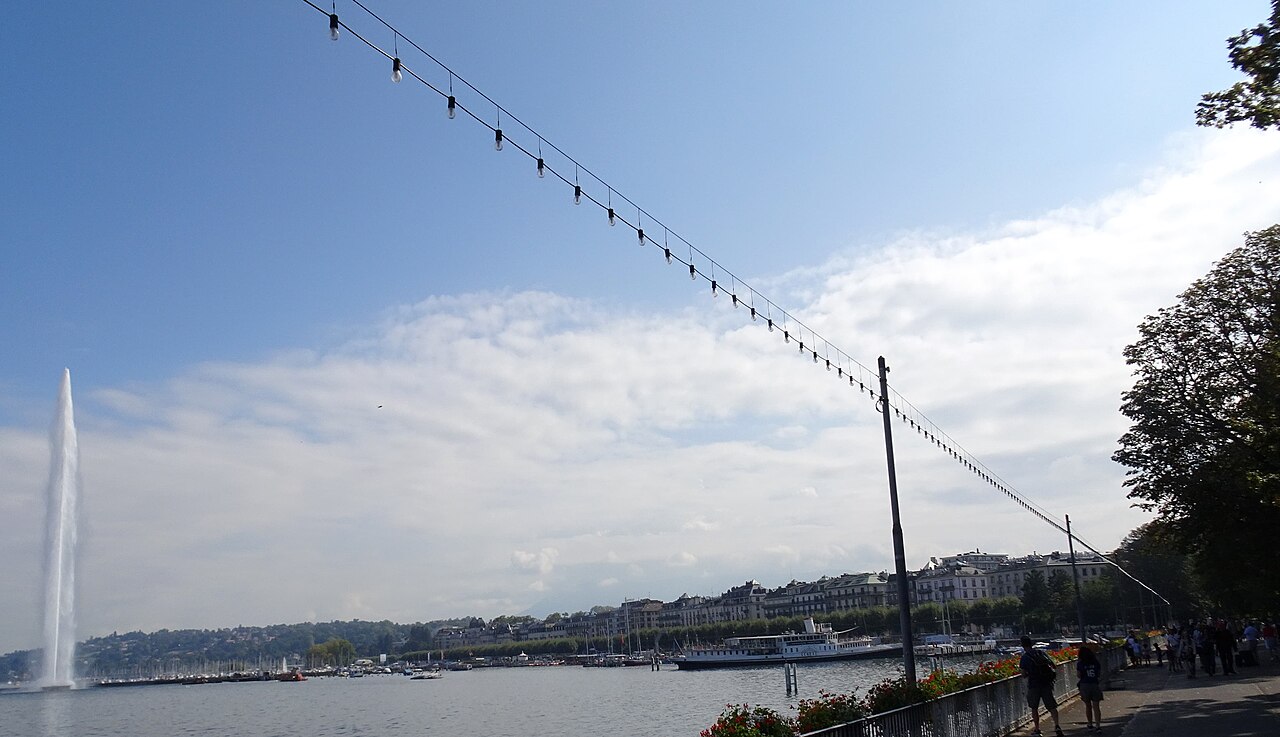
The Jet d’eau and Bains des Pâquis across the harbour
Rising dramatically above the harbour is the Jet d’eau, Geneva's defining water monument. The giant plume began in 1885 as an ordinary safety valve to relieve excess hydraulic pressure at the Forces Motrices de la Coulouvrenière power station. In 1891, the municipal authorities moved the fountain directly into the harbour basin to turn it into a landmark for visitors. The installation in place since 1951 employs twin pumps totaling around 1,000 kilowatts, shooting 500 litres of lake water per second into the air at speeds of 200 km/h, though it shuts down when freezing temperatures or fierce winds threaten the harbour. The historic public bathhouse of Bains des Pâquis sits along the water.
First erected in 1872 as wooden bathing platforms between the harbor mole and the Pâquis bank, the site gained its lighthouse, the Phare des Pâquis, at the jetty tip in 1894. It was on the nearby Quai du Mont-Blanc in September 1898 that Empress Elisabeth of Austria was assassinated before boarding the steamer Genève, an event now commemorated by a bronze statue on the Rotonde du Mont-Blanc facing the Beau-Rivage hotel seventy metres away. The ship survived a fatal collision near Pully in 1928 before becoming the first vessel in the regional fleet to transition from steam to diesel in 1934.
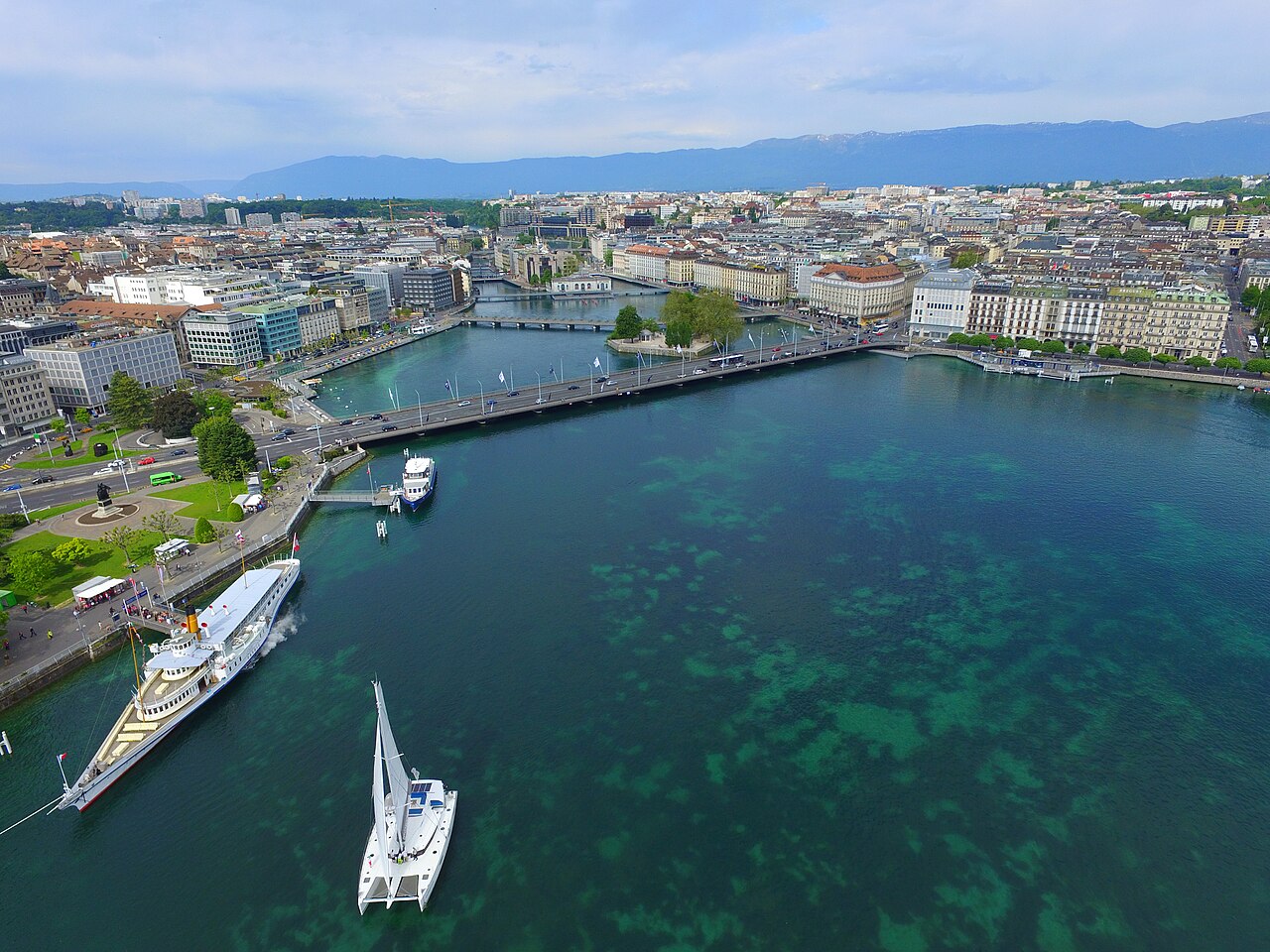
Jardin Anglais and Pont du Mont-Blanc at the Rhône outlet
Swimmers gather and finish along the shore of the Jardin Anglais, a public waterfront park established in 1854 on land reclaimed from Lake Geneva. The waterfront previously operated as a bustling transshipment port and staging area for rafts carrying timber down the lake. Today, manicured gravel avenues radiate from an ornate cast-iron fountain raised in 1862, leading toward a romantic pavilion, a rustic rockwork fountain, and the four-metre floral clock on the western lawn. During warmer months, its music bandstand hosts regular open-air concerts. The park expanded in 1862 during the building of the Pont du Mont-Blanc and grew again around 1870 when the Quai des Eaux-Vives took shape. The 250-metre-long Pont du Mont-Blanc connects the left and right banks of Geneva and forms the exact physical boundary separating Lake Geneva from the outflowing Rhône.
Just downstream sits the Île Rousseau, an ancient islet once occupied by a shipyard, renamed in 1834 when bridge connections linked it to the town, where ducks and swans shelter along the banks. Further down the river outlet stands the metal Pont de la Machine, tracing its lineage back to 1709 when engineer Joseph Abeille built Geneva’s first hydraulic pumping station there to supply municipal fountains. The Pont de la Machine gained a 600-square-metre public platform over the water in 2009, and in 2014 and 2015 it even featured a temporary floating pool shaped like a Swiss cross. Diving into the lake beside these historic channels allows swimmers in the Coupe de Noël to experience Geneva's iconic harbour at its rawest, most festive winter moment.
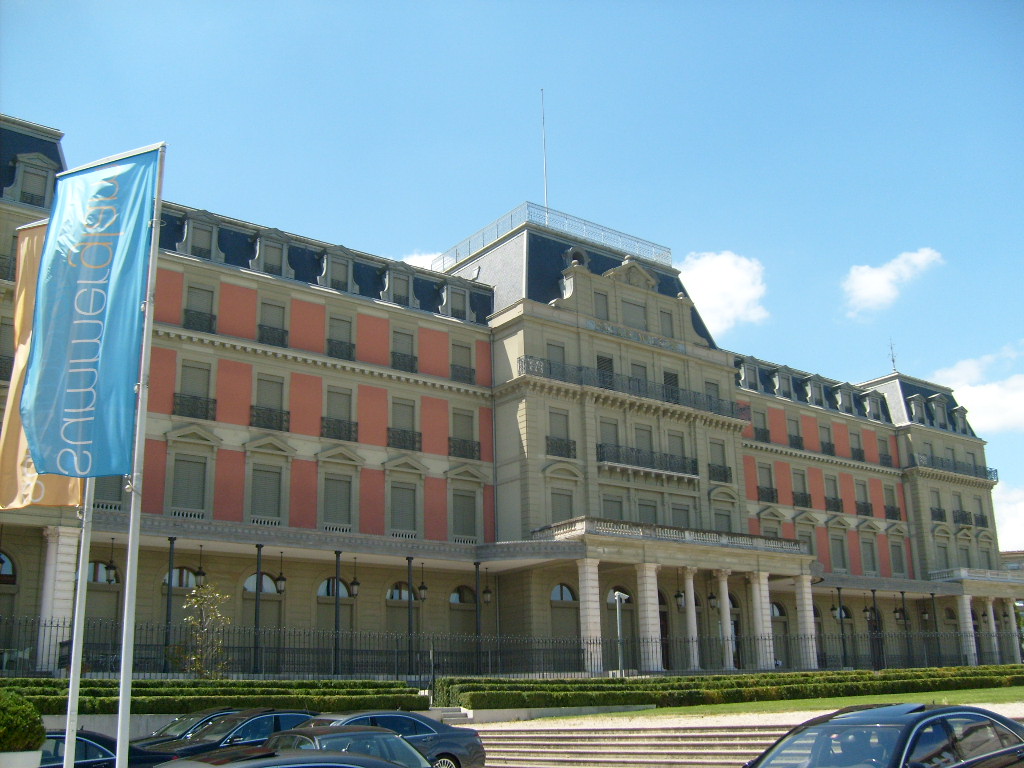
Sources: Paddle steamer Genève · Palais Wilson · Île Rousseau · Pont du Mont-Blanc · Jet d’eau · Repère Pierre du Niton · Bains des Pâquis · Denkmal für Kaiserin Elisabeth von Österreich-Ungarn
Course
Previous editions
- 2024results
How to get there
Coupe de Noël
Frequently asked questions
- When is Coupe de Noël?
- Coupe de Noël takes place on December 20, 2026.
- What distances does Coupe de Noël offer?
- Coupe de Noël has a single distance: 100 m.
- How much is the entry fee for Coupe de Noël?
- The entry fee is 40 CHF. Registration fee for the 100m race set at CHF 40 per participant.
- Where does Coupe de Noël take place?
- Coupe de Noël is a lake swim. Location: Rade de Genève – Jardin Anglais, Genève, Switzerland.
- How do I register for Coupe de Noël?
- The reference page for registering for Coupe de Noël is https://www.coupedenoel.ch/.
Where to stay
The area surrounding the Rade de Genève offers a range of stays, from historic boutique hotels overlooking the harbor, which can exceed 350 CHF per night, to more accessible urban apartments and seasonal guesthouses. For those seeking proximity to the start line at Jardin Anglais, the hotels along the Quai du Mont-Blanc provide easy access to the water. Budget-conscious participants often opt for hostels or smaller properties further from the lakefront, typically ranging from 120 to 200 CHF per night depending on the season.
Things to do nearby
Geneva in winter invites visitors to explore the city's cultural depth through its numerous museums and the historic Old Town. Beyond the swim, you can engage in guided architectural walking tours or visit local chocolate workshops for seasonal tastings. While summer activities like kayak and SUP rentals on the lake are paused, the nearby mountain resorts offer world-class skiing and trekking, all within a short train ride from the city center, providing a stark, wintry contrast to the harbor swim.
Swimmers
Similar races


Comments
Transparency: some links on this page (stays, flights, experiences, gear) are affiliate links — if you book or buy through them, Omniathlon may earn a commission from the partner at no extra cost to you. As an Amazon Associate we earn from qualifying purchases.