It is a well-known fact that a wetsuit helps with buoyancy, glide, and heat retention, but the extent of its influence is a fascinating topic that we simply had to dedicate an article to. In our literature review, we observed that most studies focus on elite athletes and short events. For example, of the 26 studies collected in the review by Gay et al. (2022), more than half concern regional, national, or international level swimmers and triathletes, and almost all are conducted in pools or flumes, over distances ranging from 25 to 1,500 meters or lasting between 5 and 30 minutes (only one reaches 75), with only two taking place in open water. Amateurs and ultra-marathon swimmers appear in very few works, but we have tried to synthesize the information that matters most to them and to us.
In real open water conditions, including the distances that define long-distance and ultra-endurance swimming (5, 10, 20, and 30 kilometers), the aseptic conditions of studies conducted in controlled environments (pools or flumes) clash with many more variables. Indeed, during a 7 or 12-hour crossing, the performance of equipment does not depend solely on surface drag or instantaneous hydrostatic displacement; other factors also come into play:
- The progressive degradation of body position that increases with fatigue (kinematic decay of body position) (some do not need to be tired to have a degraded position);
- The thermal balance between heat produced by muscles and heat removed by forced convection from cold water (thermal balance by forced convection);
- The maximum physiological amount of carbohydrates that the swimmer's body can digest during exertion (physiological ceiling of intestinal carbohydrate absorption) (though a study on what we are capable of eating after the effort would also be needed);
- The muscular and joint toll that neoprene can impose on shoulders and neck after tens of thousands of strokes (biomechanical cost of functional overload);
- Weather and sea conditions;
- The technical skills of the swimmers (yes, those are often quite lacking as well...).
The purpose of this article is to compare data from scientific literature in the field with empirical feedback from the community, the numerical models of the time predictor (Crossing Time Predictor) that we developed with Omniathlon (and which are based on this study), and the field experience of crossings.
1. The mechanics of buoyancy (or rather, sinking): the principle of torque
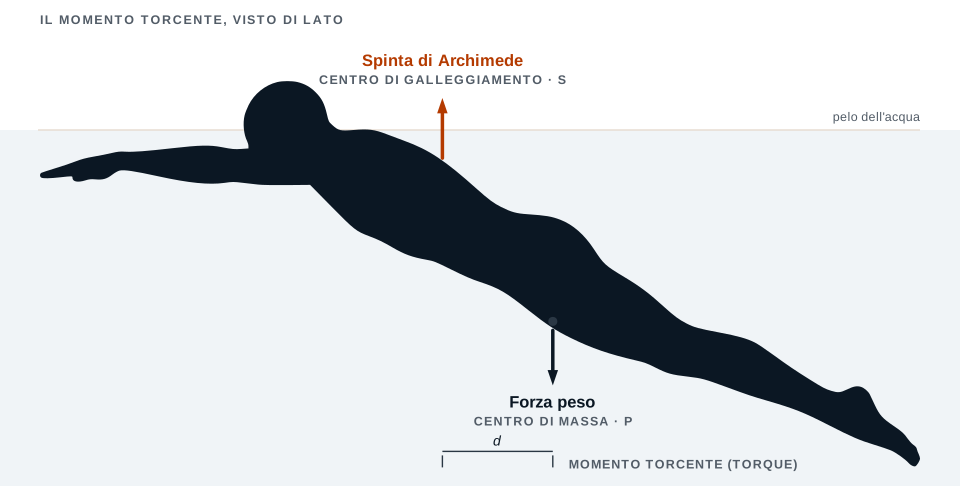
To understand why a wetsuit benefits swimmers unequally, we must start with the physics of body buoyancy. When lying still in the water, the body is subject to two opposing vertical forces that do not pass through the same point:
- The weight force (P) acts downwards and is applied at the center of mass, which C. Capelli et al. (1995) place at approximately 56% of height starting from the heels, or more or less at waist level;
- The buoyant force (S) acts upwards and is applied at the center of buoyancy, which lungs full of air shift towards the chest (Yanai & Wilson, 2008).
The horizontal distance between these two points generates a torque that rotates the body, sending the legs downwards. In simple terms: the legs are heavy and tend to sink (especially those of triathletes), while lungs full of air float. C. Capelli and colleagues (1995) measure this as underwater torque: the force with which the feet tend to sink, multiplied by the distance between the feet and the center of volume of the lungs. Their experiment involved 18 swimmers: ten amateurs at a speed of around 0.7 m/s (2'23"/100 m) and eight elite university competitors, made to swim at two set paces requiring less than 85% of their maximum oxygen consumption, at 1.0 and 1.23 m/s (1'40" and 1'21"). The speeds were slow so that oxygen consumption would be sufficient to determine how much energy they were spending, and everyone swam with measuring equipment attached (a breathing valve and a tube tied to the waist). In all subjects, torque proved to be the main determinant of the energy cost of the swim, regardless of ability or sex. These types of studies usually provide speeds in meters per second; to facilitate reading, we have placed the pace per 100 m in parentheses next to each. To do the math yourself, to and from min/100 m, m/s, min/km, km/h, or parsecs/min or any other unit of measurement you use, we have created a dedicated tool that you can find in the "Convert pace" tab of our Pace Calculator.
When the legs drop, the body presents a larger frontal section to the water. In fluid dynamics, the resistance due to shape (form drag) grows in proportion to the frontal section and the square of the velocity (v²), according to the relation D = ½ · ρ · v² · A · Cd — where ρ is the density of the fluid, A is the projected frontal area, and Cd is the drag coefficient. This is how Chatard et al. (1995) interpret their data: at low speeds, legs and feet tend to sink and increase the frontal area, while with a wetsuit, one can achieve a more horizontal position and therefore decrease the frontal section and consequently the resistance to forward motion.
While this is true statically, how much of this applies while swimming is a subject of debate. Yanai & Wilson (2008) point out that in the front crawl, one arm, the shoulder, and part of the head are out of the water: the center of buoyancy moves backward and the buoyant force, instead of sinking the legs, lifts them. This is what resulted from a previous study by Yanai (2001) on eleven university team swimmers captured on video. In their model, what pulls the legs down are the forces that the hands exert on the water, and the kick serves to compensate for them. It is a theoretical framework, and Yanai and Wilson themselves call for experiments to confirm it. On one point, however, all studies agree: those who float higher encounter less resistance. Cortesi et al. (2014) measured this by towing fourteen swimmers between 1.6 and 2.0 m/s (from 1'03" to 50"/100 m): for every additional degree of leg lift, resistance dropped by about 1% (the percentage is our own calculation based on their coefficients). Wetsuits are mainly used for this: to raise the waterline, and especially that of the legs.
Those who are slow gain more
The hydrostatic lift added by a wetsuit was measured by Chatard et al. (1995) in an experiment. Sixteen athletes were made to float face down, curled in a fetal position after a maximum inhalation, while weights were placed on their backs at the level of the shoulder blades until they remained in equilibrium just below the surface of the water. The load that keeps them at the surface is equal to their hydrostatic lift. With a full wetsuit, 5 mm thick on the torso and 3 mm on the arms and legs, all sixteen athletes in the study needed 39 N of extra lead to remain at the surface. Doing the math, 39 N divided by the acceleration of gravity, 9.81 m/s², equals 4 kg (8.8 lb). In other words, we can say that the wetsuit pushes upwards as much as a float capable of supporting 4 kg (8.8 lb).
If we can deduce that the effect of a wetsuit on static buoyancy is identical for everyone, the dynamic effect presents some very interesting differences. In the same study, after having "statically weighed" them, Chatard et al. (1995) divided them into competitive swimmers (8) and triathletes (8). They were all international-level athletes, using the same full wetsuit and subjected to the same 400-meter test in a pool at 26 °C (79 °F). The triathletes with the wetsuit went from 5'04"7 to 4'45"8: 19 seconds, or 6%. The swimmers, on the other hand, went from 4'13"9 to 4'12"5, a difference of only 1.4 seconds, or 0.55%. In short, triathletes gain a lot, while swimmers gain so little that the difference is not statistically significant.
The reasons for this difference, according to Chatard and colleagues, are three.
- Wetsuit habituation. The swimmers were not trained to use it, and with it on, they could not push to their maximum. This would be proven by the fact that at the end of the test, oxygen consumption and lactate were lower than in a swimsuit. The triathletes, who instead trained regularly with a wetsuit, increased their stroke rate. For the authors, this is the main explanation for the discrepancy.
- Speed. Towed in the water at increasing speeds, the triathletes encountered less resistance with the wetsuit: 22% less at 1.1 m/s (1'31"/100 m), 14% at 1.3 m/s (1'17"), and 9% at 1.6 m/s (1'03"). Above 1.4 m/s (1'11"), the authors write, legs and feet are already held horizontal by the speed itself, and the wetsuit has little left to correct. In competitive swimmers, resistance did not change at any speed.
- Initial buoyancy. The swimmers floated better than the triathletes due to greater lung capacity and thicker fat folds. Among the sixteen athletes, the less hydrostatic lift they had, the more time they gained: at the same lactate level, 19.6 N less lift was worth 12 seconds over 400 meters. Cordain & Kopriva (1991) observed something similar among 14 competitive female swimmers: with a wetsuit, the leaner and denser ones swam faster than the others, whereas in a swimsuit they did not, deducing that those who are lean gain more from a wetsuit.
Toussaint et al. (1989) measured, in twelve athletes swimming with a pull buoy and a sleeveless wetsuit, a 14% lower resistance at 1.25 m/s (1'20"/100 m) and calculated that, at the same power and efficiency, this would correspond to a speed increase of about 5% compared to the same swimmer with a pull buoy and without a wetsuit.
A second comparison between swimmers and triathletes, which we know only through the review by Gay et al. (2022), points in the same direction: a gain between 6 and 7% for a group of regional swimmers and between 8 and 11% for a group of national triathletes.
The conclusion of these studies, which gives this paragraph its title, is that the wetsuit improves performance especially in less efficient swimmers, those with less buoyancy, and/or those who swim at low speeds.
What it is worth in seconds
Between 1'03" and 1'31" per 100 meters, we have the towing resistance measured by Chatard on his triathletes. From that, the gain can only be estimated, and we do so using the Toussaint proportion: if 14% less resistance is worth about 5% speed, the gain is more or less a third of the removed resistance. The proportion holds roughly even where resistance and stopwatch times were measured on the same garment: in the two studies on full-body swimsuits, the gain is between a third and half of the removed resistance (Chatard & Wilson, 2008; Ueberschär et al., 2018).
Below 1.1 m/s (1'31"/100 m), no one has measured resistance, while the gain has been measured in three studies:
- four sports science students who had been swimming front crawl for more than six months, over 100 meters in water at 26 °C (79 °F), went from 1'36" to 1'23"5 in the averages declared by the authors, about a 13% gain (Pavlík et al., 2015). These are four people (therefore a very small sample) and it is a minute-and-a-half test (not exactly an open water race);
- 12 triathletes over 1,500 meters with a sleeveless suit, in water at 17 °C (63 °F): 3'10" less, 10%. This is the study by Lowdon and colleagues (1992), which we know second-hand from how it is reported in the review by Gay et al. (2022). If 3'10" is 10%, in a swimsuit they were swimming around 2'07"/100 m and should have done the 1500 m in about 31'40" in a swimsuit and 28'30" with a wetsuit (but the calculation is ours and done backwards starting from the percentage gain figure);
- 14 triathletes, from beginners to elite, two 30-minute tests in an outdoor pool at 18 °C (64 °F), with and without a sleeveless wetsuit. In a swimsuit, they maintained an average of 2'09"/100 m; with the wetsuit, they covered 7% more distance (Parsons & Day, 1986). The pace is our own calculation based on the 66-yard pool described in the method (the summary of the study gives it as 66 meters, and in that case, it would be 1'57"5). The authors cannot say how much is due to buoyancy and how much to the cold, which slows down those swimming in a swimsuit, but they lean towards buoyancy. The main limitation is that it is a 1986 study done on wetsuits made of 40-year-old neoprene.
Trying to put everything into an overall picture, we get that:
| Speed(pace per 100 m) | Less resistance with wetsuit | Gain | Per 100 m |
|---|---|---|---|
| 1.6 m/s(1'03") | 9% | 3.0% | 1.8 s |
| 1.5 m/s(1'07") | 10% | 3.3% | 2.2 s |
| 1.4 m/s(1'11") | 11% | 3.7% | 2.5 s |
| 1.3 m/s(1'17") | 14% | 4.7% | 3.4 s |
| 1.2 m/s(1'23") | 18% | 6.0% | 4.7 s |
| 1.1 m/s(1'31") | 22% | 7.3% | 6.2 s |
| 1.04 m/s(1'36") | not measured | 13% | 12.9 s |
| 0.79 m/s(2'07") | not measured | 10% | 12.7 s |
| 0.78 m/s(2'09") | not measured | 7% | 8.8 s |
This is a rough estimate that must be compared and weighed against other measurements. Chatard's triathletes were only 8, and swimming at an average of 1.31 m/s (1'16"/100 m), they gained 6%. Our estimate, based on calculations, is more conservative and stops at a 4.7% gain (or 3.4 s per 100 m). Cordain's swimmers, between 1.37 and 1.43 m/s (from 1'13" to 1'10"), gained between 3.2 and 5.0% with a sleeveless suit. The 33 open water swimmers and triathletes of Gay et al. (2020), at 1.17 m/s (1'25"), gained about 6% over 400 meters. Other measurements are both lower (the regional swimmers and national triathletes of de Lucas et al. (2000) gained 3.7% over 1,500 meters at 1.17 m/s (1'25"), and Chatard's competitive swimmers, at 1.58 m/s (1'03"), gained 0.5%, where the estimate would suggest 3%) and higher (seven national triathletes over 400 meters went from 5'45" to 5'08", almost 11% (Hutteau et al., 2007)). And within the same group, the differences are enormous: in Toussaint's twelve, at 1.1 m/s (1'31"), the wetsuit removed between 4% and 36% of the resistance. These are relatively small numerical samples, and it is truly difficult to generalize; however, net of the percentage differences in the range, the trend is always the same. Between 1'03" and 1'31", the estimated gain grows 2.4 times in percentage and 3.4 times in seconds per 100 meters (going from 1.8 seconds per 100 m with a pace of 1'03" up to a 6.2-second gain with a pace of 1'31" per 100).
For paces slower than 1'31", the last three rows of the table are all we have. They are direct measurements but few, made on four, twelve, and fourteen people with different wetsuits and tests. For those who swim around 2'/100 m, they suggest that the gain could be between 7 and 10%, that is, between 9 and 13 seconds every 100 meters.
Comparisons in open water can only be retrospective and refer to different people, but they still give us interesting clues that point in the same direction. In the Lake Zurich marathon, 26.4 km (16.4 mi), between 2002 and 2012, men with a wetsuit finished on average in 534 minutes and those without in 551: 3.1% less, a relevant difference but not as marked as we would have expected. Among the top three ever, the gap rises to 5.9%. In another race, over 3.8 km (2.4 mi), the top ten women with a wetsuit were 6.5% faster, but across the total finishers, there is no difference (Ulsamer et al., 2014). The authors suppose that those who choose a wetsuit are more often triathletes and those who swim in a swimsuit are more experienced long-distance swimmers, so the data should be taken as a clue. It does say, however, that in a nine-hour race, at a pace around 2'/100 m, the advantage seems to be smaller than that measured in a pool, but still present.
We tried to redo the calculation on the Italian Open Water Tour 2026 rankings, between 4 and 7 km (2.5-4.3 mi). The ranking separates those who swim without a wetsuit (the "Natural" category) from everyone else: 1,260 finishers, 832 with a wetsuit and 428 without. In each race, we removed the fastest 10% and the slowest 10% of each group, compared men with men and women with women, and calculated the weighted average based on the number of swimmers. At a pace between 1'55" and 2'/100 m, those who had a wetsuit were 3.1% faster, coincidentally the same number as in Zurich. Over the 33 km (21 mi) of the Charente, at Le Flow des Gabarriers, male swimmers with a wetsuit were 6% faster in 2025 (25 vs 8) and on par in 2026 (27 vs 9). The limitation is the same as in Zurich: they are different people, and therefore these numbers mix the effect of the wetsuit with the type of swimmer who chooses it.
In our Crossing Time Predictor, we have tried to take all these factors into account.
2. Comparing the four types of equipment: physics, materials and the stopwatch
The table below compares "Swimsuit", "Technical swimskin", "Sleeveless wetsuit" and "Full wetsuit". For the technical swimskin approved for open water races, there is only one study, which compares it to a wetsuit rather than a swimsuit, but we have integrated the data with technical pool swimsuits from Sydney 2000 and 2017 triathlon suits (speedsuit), as the data is quite similar.
| Parameter | Swimsuit | Technical swimskin | Sleeveless wetsuit | Full wetsuit |
|---|---|---|---|---|
| Material | Stretch fabric | Thin and elastic fabric: polyester and elastane in 2000 models, polyamide and elastane in today's models | Neoprene on torso and legs, free arms | Neoprene: synthetic rubber with small gas bubbles |
| Thickness | — | "Almost as thin as paper"; no more than 0.8 mm by regulation | 2–3 mm in studies that declare it | Up to 5 mm by regulation; 3.15 mm the average of the wetsuits studied |
| Buoyancy | That of the swimmer | Unchanged; no more than 0.5 N by regulation | Body density from 1.048 to 1.021 g/ml with a 3 mm sleeveless | 39 N of extra lift, approximately 4 kg (8.8 lb) |
| Drag | Reference | Passive. 2000 models: −6.2% (shoulder to ankle), −4.7% (waist to ankle). 2017 triathlon models: from −7.2% at 1.1 m/s (1'31"/100 m) to −4.4% at 1.7 m/s (59") | Active, swimming with arms only: from −16% at 1.1 m/s (1'31"/100 m) to −12% at 1.5 m/s (1'07") | Passive: from −22% at 1.1 m/s (1'31"/100 m) to −9% at 1.6 m/s (1'03") in triathletes; no difference in competitive swimmers |
| Measured gain | Reference | 2000 models: 3.2% (shoulder to ankle) and 1.8% (waist to ankle) between 25 and 800 m in competitive swimmers. 2017 triathlon models: 1.5% over 100 m in triathletes. Tri-suit: 4.4% over 400 m and 3.2% over 750 m, in two groups of triathletes | 5.0% over 400 m and 3.2% over 1,500 m in competitive female swimmers; 7% in half an hour in triathletes | Over 400 m from 0.5% in international swimmers to 6% in triathletes; almost 11% in another group of triathletes |
| Energy cost | Reference | 2000 models: −4.5% / −5.5%. 2017 models: at same speed heart rate −4% and lactate −26% | Oxygen consumption halfway between swimsuit and full wetsuit (data reported by the review) | In triathletes from −20% at 1.1 m/s (1'31"/100 m) to −7% at 1.3 m/s (1'17"); −14% in master swimmers at 18 °C (64 °F) |
| Cold | At 16 °C (61 °F) half of lean swimmers do not finish the two hours | No data in the cold. In water at 28 °C (82 °F), over 750 m, a tri-suit did not raise internal temperature more than a swimsuit | Same critical temperature as the full wetsuit (15.1 °C (59.2 °F)), but with colder skin and more heat to produce | Critical temperature around 15 °C (59 °F) |
| Shoulders | Free | Free | Increasingly used for shoulder comfort | Possible discomfort and movement limitation (review hypothesis); no difference measured in the deltoid; in three elite swimmers, stroke rate was higher and the stroke shorter than with the swimskin |
Sources: Chatard et al. (1995), Cordain & Kopriva (1991), Parsons & Day (1986), Toussaint et al. (1989), Chatard & Wilson (2008), Hutteau et al. (2007), Peeling & Landers (2007), Ueberschär et al. (2018), Zacca et al. (2022), Gay et al. (2021), Gay et al. (2022), Lim et al. (2023), Saycell et al. (2019), Skutnik et al. (2026), Cox (2013).
On the stopwatch, the swimskin impacts about half as much as the wetsuit, and on drag and energy cost about a third: the main difference is buoyancy, which the wetsuit adds and the swimskin does not offer (Chatard & Wilson, 2008). In the only direct comparison, on three elite swimmers (therefore a very small sample), the wetsuit was 2–3% faster than the swimskin (Zacca et al., 2022). Compared to the stopwatch advantage, the sleeveless wetsuit, as far as it has been measured, does not perform worse than the full wetsuit; however, at the same speed it consumes between 10 and 22% more oxygen (data reported by the review by Gay et al., 2022) and in the cold it demands more heat from the body.
3. From the pool to the marathon: what happens at 5, 10, 20 and 30 km
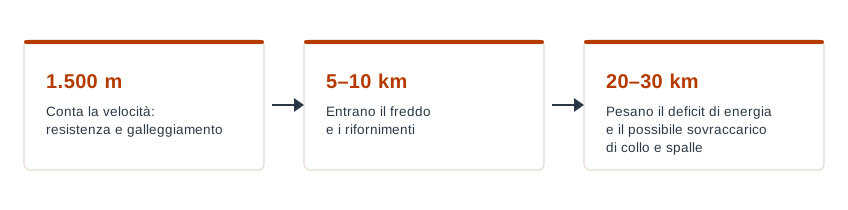
In the 1,500-meter event, the effort lasts from less than twenty minutes to just over half an hour: too short for glycogen stores to run out or for the cold to penetrate deeply, and the stroke count is only a few thousand.
When the distance increases, the numbers change because other factors come into play. At the 2022 World Championships, 10 km (6.2 mi) swimmers maintained an average of between 35 and 39 cycles per minute, which is 70–78 strokes (Fernández-Asensio et al., 2024). This means that in about two hours of racing, they take between 8,000 and 10,000 strokes. At the same frequency, a 25 km (16 mi) race lasting 4–5 hours (Shaw et al., 2014) would require between 17,000 and 23,000. An amateur who takes nine hours for 26 km (16 mi), like the men in the Lake Zurich marathon, at 22–33 cycles per minute (the range here is wider) would take between 24,000 and 36,000.
At that point, three factors come into play.
A. Fatigue (neoprene doesn't get tired)
In the study by Zamparo et al. (2005), ten elite distance swimmers swam 2 km (1.2 mi) at 10 km (6.2 mi) pace. At the end of the 2 km (1.2 mi), the energy cost of the swim (Cs, the energy spent per meter) was 21 ± 26% (P < 0.05) higher than that measured at a practically identical speed during 400-meter trials. The authors link this to the decrease in distance per stroke and therefore in propulsive efficiency.
Those who swim less efficiently start with a higher cost. Comparing amateur distance swimmers and Ironman triathletes before and after 1,829 meters, DiGeronimo (2010) found that triathletes spend more energy per meter (1.02 vs 0.76 kJ/m) and are the only ones whose stroke length shortens significantly by the end of the trial, though without an increase in energy cost, likely due to a slowing of the pace.
- Without a wetsuit: as the hours pass, the stroke shortens and efficiency drops. It is reasonable to think that keeping the legs high costs more and more, but this has not yet been precisely measured over a multi-hour race.
- With a wetsuit: the buoyancy of neoprene does not depend on muscles. The review by Gay et al. (2022) puts forward the hypothesis that a wetsuit can reduce local fatigue and help maintain speed, but this too remains to be measured over distances lasting several hours.
In the Omniathlon tools, fatigue is a correction that grows in a straight line with the length of the race, up to +21% from 20 km (12 mi) onwards: in the Race Fueling Planner it increases consumption, while in the Crossing Time Predictor it slows down the pace declared over a mile.
B. The caloric toll of the cold (The Cold Tax)
Water conducts heat about 25 times better than air (Hue et al., 2015) and a swimmer's body loses heat primarily through conduction and convection (Saycell et al., 2019).
A team from the University of Granada, Gay et al. (2021), measured what changes with and without a wetsuit on 17 master swimmers in a counter-current pool at their 400-meter pace, in water at 26 °C (79 °F) and 18 °C (64 °F). At 18 °C (64 °F), comparing a swimsuit to a wetsuit:
- Total energy expenditure drops from 366 ± 74 kJ in a swimsuit to 315 ± 61 kJ with a wetsuit: 14.0% less (P = 0.04);
- The energy cost per meter drops from 0.92 ± 0.19 kJ/m to 0.79 ± 0.15 kJ/m (−14.0%);
- Maximum heart rate goes from 183 ± 19 bpm in a swimsuit to 154 ± 12 bpm with a wetsuit (28.7 beats per minute less at the same speed);
- Peak lactate drops from 7.99 ± 4.38 mmol/l to 5.21 ± 2.65 mmol/l (−34.9%).
In the University of Granada experiment, caloric expenditure at 18 °C (64 °F) turned out to be the same as at 26 °C (366 vs 370 kJ). The authors write that, contrary to their expectations, swimming in a swimsuit at 18 °C (64 °F) did not increase physiological strain. The 14% is therefore the gain from the wetsuit itself. However, there is an important detail: since the trials lasted only five or six minutes (and water at 18 °C (64 °F) is not truly cold), the cold did not yet have a significant impact on performance.
The bill, in fact, arrives as the activity is prolonged. In a short and intense effort, the heat produced by the muscles is enough to compensate, and after 20 minutes of high-intensity exercise in 17 °C (63 °F) water, the core temperature of trained, non-obese subjects can even be slightly higher (Costill et al., reported by Tipton & Bradford, 2014). Over longer distances, however, the pace drops. Zamparo et al. (2005) estimate that at the World Championships, distance swimmers swam the 25 km (16 mi) at about 63–64% of their maximum aerobic power, compared to 91–97% for the 10 km (6.2 mi).
At that point, the cold influences performance in three ways:
- It costs oxygen: an important defense against hypothermia is shivering. At 18 °C (64 °F), at a sub-maximal pace, one consumes about half a liter of oxygen per minute more than at 34 °C (Holmér and Bergh, reported by Baldassarre et al., 2017). In energy terms, this is about 150 kcal per hour (0.5 l/min times 20.9 kJ per liter). The increase is seen at moderate paces and not at more intense ones (Tipton & Bradford, 2014);
- It burns carbohydrates: cold muscle resorts to anaerobic metabolism at lower loads, which can deplete stores sooner (Tipton & Bradford, 2014);
- It reduces power: less blood reaches the muscles, and for every degree drop in muscle temperature, maximum power drops by about 3% (Tipton & Bradford, 2014).
C. The nutritional bottleneck
There is another factor that complicates the picture. In ultra-marathons, the limit is not just muscle strength but also how much the intestine can absorb.
Glucose passes through a single intestinal transporter, SGLT1, which saturates at around 1 g per minute; by adding fructose, which uses another (GLUT5), in a 2 to 1 ratio, one can reach 80–90 g per hour (Burke et al., 2011; Shaw et al., 2014). Studies measuring the fueling of an endurance swimmer during a race are very limited. Kumstát et al. followed an elite swimmer in the seven races of the 2014 FINA Grand Prix who maintained an average of 83 ± 5 g/h, equal to 394 ± 26 kcal/h (Kumstát et al., 2016). These are races that push beyond the theoretical limits of glycogen stores, and we are talking about a professional athlete with training volumes of about 2,400 km (1,491 mi) / year + 330 km (205 mi) of racing / year.
Returning to "mere mortals" in the Lake Zurich marathon (assuming that amateur athletes who swim 26.4 km (16.4 mi) in 23–24 °C (73-75 °F) water can be considered "mere mortals"), Weitkunat et al. (2012) followed twenty men and eleven women in the 2009 and 2010 editions. The men, who finished in an average of nine hours, ingested 2,839 kcal against an estimated expenditure of 6,554 kcal: a deficit of 3,715 kcal. The women, in ten hours, ingested 1,901 kcal against an estimated 5,076, but everyone finished the race. Per hour, that is 325 kcal ingested by the men and 199 by the women. The study does not separate carbohydrates, but if those calories were all sugars, it would be 81 g per hour for the men and 50 g for the women.
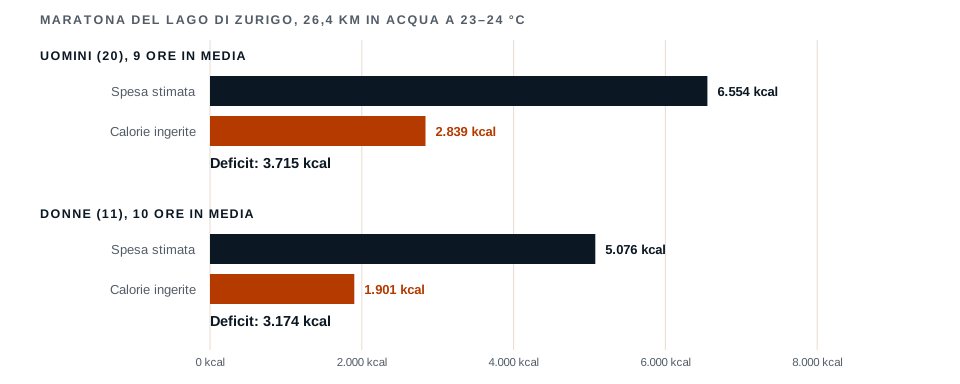
In a race like this, the deficit is large but manageable. In the Weitkunat et al. study just cited, caloric expenditure is calculated based on weight, speed, and duration, but it does not distinguish between those who swam in a wetsuit and those who swam in a swimsuit. To get an idea of how much a wetsuit can reduce the deficit, we can only do a calculation: the 14% measured by Gay, applied to the 6,554 kcal of Zurich, would be about 900 kcal, but this is only to provide an order of magnitude, given that Gay measured over five minutes at 400-meter pace and we are comparing it with an average of nine hours in Zurich.
4. The English Channel, regulations, and the reality of the cold
It is clear that swimming the English Channel (or any crossing between 15 and 18 °C (59-64 °F)) in a wetsuit is much easier than doing it without one.
Without a wetsuit, the English Channel is an absolute challenge; with a wetsuit, it becomes a very long endurance test within the reach of a significantly larger number of athletes. The crossing is 33.7 km (20.9 mi) in a straight line, but with the tides, the actual distance covered is much greater. Those who complete it in a swimsuit take an average of nearly thirteen hours if they are men and twelve if they are women Nikolaidis et al. (2018). The benefits of a wetsuit are that it wards off hypothermia, allows one to swim with a lower body fat percentage (without having to undergo months of cold acclimation), and shaves some time off the final result (between half an hour and 1 hour).
If wetsuits are not used in the English Channel and other great historic swims (Catalina, the Manhattan circumnavigation, the Cook Strait, or the frigid North Channel), it is due to a precise ethical and regulatory choice:
| Parameter | World Aquatics (formerly FINA) | Traditional marathon swimming |
|---|---|---|
| Race | 10 km (6.2 mi): about 1h50' for men, 2h for women | Channel or crossing, 12-20 h |
| Athletes | lean swimmers, similar to pool swimmers | long-distance swimmers with significant subcutaneous fat |
| Wetsuit | mandatory below 18 °C (64 °F), prohibited above 20 °C (68 °F) | prohibited |
| Below 16 °C (61 °F) | the race does not take place | this is the normal condition |
| Philosophy | sterile environment, speed | men and women against the sea, in swimsuits and goggles |
The rules of the Channel Swimming Association (CSA) only allow a swimsuit, a swim cap, goggles, and grease on the skin. It is the spirit of the first crossings, such as that of Captain Matthew Webb in 1875: the human being against the elements (although, to be pedantic, Webb did not have goggles, as we recount in our history of swimming goggles). If you wear a wetsuit (or a swimskin), your crossing is not ratifiable by the CSA as an English Channel swim and is considered assisted.
Conversely, the regulations of World Aquatics (open water rules) do not allow races below 16 °C (61 °F) and, since 2017, have mandated wetsuits below 18 °C (64 °F). Between 18 and 20 °C (64-68 °F) it is optional, but to compete on equal terms, almost everyone wears one (Zacca et al., 2022). The wetsuit rule was created to protect today's elite swimmers, who are as lean as pool swimmers and, without the insulation of "bioprene" (a few kg of subcutaneous fat), cool down quickly at 16 °C (61 °F). In the study that led to the change in regulations, twelve lean swimmers swam in swimsuits for up to two hours: at 16 °C (61 °F), half of them did not finish, and the four leanest reached an internal temperature of 35 °C (95 °F), or would have reached it according to the authors' projections, between 50 and 73 minutes (Saycell et al., 2019). Following this study, FINA introduced the mandatory use of wetsuits starting at 18 degrees. The 16 °C (61 °F) limit was then tested in a very recent study, but with wetsuits on. Twenty trained swimmers, with a 5 mm homologated wetsuit, swam for up to two hours in water that started at 16 °C (61 °F) and dropped by 0.15 °C (0.3 °F) every ten minutes. The body stopped maintaining its internal temperature when the water was around 15 °C (59 °F), one degree below the limit. The authors still recommend leaving the rule as it is to have a safety margin (Skutnik et al., 2026). In the world of marathon swimming, the temperature thresholds of World Aquatics are viewed with some amusement.
Triathlon has its own rules, which are a bit more generous. In the United Kingdom, the guidelines of British Triathlon, as reported by Tipton & Bradford (2014), were as follows:
- the minimum water temperature at which a wetsuit is optional is 14 °C (57 °F);
- below 11 °C (52 °F), it is recommended not to swim in open water;
- the maximum swimming distance is restricted: 2,000 m at 13 °C (55 °F), 1,000 m at 12 °C (54 °F), 500 m at 11 °C (52 °F);
- wetsuits are prohibited or mandatory according to distance and temperature: up to 1,500 m they are prohibited above 22 °C (72 °F) and mandatory below 14 °C (57 °F); from 1,501 to 3,000 m above 23 °C (73 °F) and below 15 °C (59 °F); from 3,001 to 4,000 m above 24 °C (75 °F) and below 16 °C (61 °F).
The biological metamorphosis of the channel swimmer
To swim without a wetsuit for 10–20 hours in 16-degree water, the swimmer needs a series of adaptations that physiology has described:
- Fat as insulation: the English Channel race competitors measured by Pugh & Edholm (1955) had on average twice the subcutaneous fat of a comparison group of British workers, and none of them were lean. Fat, the authors report from measurements taken on tissue samples, insulates about three times better than muscle. The skin, on the other hand, drops almost to the temperature of the water anyway (Tipton et al., 2008).
- Cold habituation: there are three ways the body can adapt: let the temperature drop, insulate better, or produce more heat (Tipton et al., 2008). The most frequently documented is the first: the shivering threshold is lowered, discomfort decreases, and the internal temperature drops faster. This holds until the internal temperature drops below the level reached during adaptation, because the water is colder or because one stays in it longer: beyond that, shivering returns to what it was before. While swimming, an insulating adaptation also appears (Tipton & Bradford, 2014). Whether the body learns to produce more heat without shivering and without detracting from the stroke is a hypothesis not yet fully verified. It is proposed by the study on the Foveaux Strait crossing, where the swimmer remained in total for more than six hours below 35 °C (95 °F) internal temperature while swimming normally (Roxburgh et al., 2026); an experiment in which, after eight repeated forearm coolings, the oxygen consumption of the cold muscle tended to be higher, points in the same direction (Wakabayashi et al., 2013). There is certainly a downside: those who are acclimatized feel less cold than they actually are and should be cautious about trusting their own sensations (Tipton & Bradford, 2014).
- Cold shock: hyperventilation and tachycardia peak in the first 30 seconds and subside within the first two minutes (Tipton & Bradford, 2014). Five two-minute immersions are enough to halve the response, and after 14 months it is still reduced by a quarter (Tipton et al., 2008). In experienced swimmers, the peak is the same as in beginners, but the breathing begins to calm down sooner (Button et al., 2013).
5. The law of diminishing returns: neck, shoulders, and 30,000 strokes
While it is indisputable that a wetsuit makes swimming much easier than in cold water without one, its advantage on the clock seems to narrow over longer distances. In a 1,500-meter race, a wetsuit is simply a gift: it shaves off seconds, and the event is over before any discomfort can set in. In a race lasting several hours, however, neoprene may present a small bill.
Methodological note: resistance and energy expenditure with a wetsuit have been measured in tests lasting a maximum of two hours. What happens to the neck and shoulders after tens of thousands of strokes in the open sea is not documented by controlled studies. The following combines the few available measurements, our hypotheses, and the experience of marathon swimmers.
A. The disadvantages of a lifted position
- The wetsuit keeps the body more horizontal and higher in the water. It is plausible that this forces the neck to extend more, both during a normal stroke and when lifting the eyes out of the water, but this aspect has not yet been addressed in any study;
- If this is the case, the muscles that extend the neck and lift the head (splenius capitis and cervicis, upper trapezius, levator scapulae, and sternocleidomastoid) work harder with every head rotation and even more so with every sighting to adjust the course, thousands of times over;
- Over long distances, the wetsuit chafes, and by common experience, the neck is among the most exposed areas.
B. The shoulders and the neoprene sleeve
That a full-body wetsuit fatigues the shoulders over long distances is common experience but difficult to measure. The mechanism is plausible. During the aerial recovery, the arm must deform the sleeve, and it is precisely during the recovery that the anterior deltoid and upper trapezius work harder compared to the underwater phase (Conceição et al., 2025). Hutteau et al. (2007), building on previous work, write that the neoprene of a full-body suit seems to resist the wide movements of the shoulder and that this could force an increase in stroke rate; in their 400-meter tests, however, the stroke was longest with the full-body suit. The review by Gay et al. (2022) hypothesizes discomfort and movement limitation with a full-body suit and attributes greater shoulder comfort to the sleeveless version. However, we are still talking about studies on short distances that do not take into account the elastic resistance of neoprene after 10 hours.
An attempt to measure muscle work in the water on eight triathletes—of which only five provided usable data—in 25-meter pools showed no differences in deltoid activity between wetsuits and swimsuits (Lim et al., 2023). The authors themselves warn that the pace was chosen by feel and may have been adjusted precisely to maintain the same level of effort.
An additional clue comes from three elite open-water swimmers tested one week before a stage of the Marathon Swim World Series (Zacca et al., 2022). At the same perceived exertion, the stroke rate with a full-body wetsuit increased on average by 8% at the slowest pace and by less than 2% at the most intense. At the two slowest paces, the stroke length decreased by 3–4%: more strokes to cover the same distance. After the set, shoulder power measured by throwing a medicine ball had increased by about 5% with the swimskin and had remained the same or decreased with the wetsuit. For the authors, this is weak evidence, but it aligns with what swimmers report.
All this does not mean that the wetsuit becomes slower than a swimsuit. It only means that in a race lasting several hours, its advantage could eventually diminish due to neck and shoulder fatigue, which those swimming in a swimsuit experience less.
The sleeveless suit should be the better choice in this case: it leaves the shoulders free, and on the clock, at least as far as it has been measured, it does not perform worse than the full-body version (Lim et al., 2023; Gay et al., 2022). Among triathletes, the prevailing opinion is the opposite. On Slowtwitch—though we are only talking about an informed opinion on a blog—the founder of Quintana Roo, who began producing triathlon wetsuits in 1986, writes that the sleeveless suit is about 2 seconds per 100 meters slower than the full-body version for everyone and at every distance, and that those who go slower with a full-body suit have one that fits them poorly (a non-negligible factor in our experience as well). He bases his claims on his own tests and those of his readers, not on published measurements. Following the scientific literature, it also seems that the sleeveless wetsuit has the same critical temperature as the full-body one, but for the same effort, it requires the body to generate a bit more heat and leaves the skin colder (Skutnik et al., 2026).
6. Wetsuits in warm water
Clearly, if cold makes a wetsuit an ally, warm water turns it into a problem.
Swimming generates a lot of heat: in tests by Skutnik et al. (2026), conducted in cold water with a 5 mm wetsuit, the average was about 900 watts, around 750 for women and nearly 1,000 for men. In warm water, the wetsuit obviously hinders heat dissipation:
- Neoprene is an insulator, and heat struggles to leave the skin;
- Internal temperature rises: in a pool study cited by Markey et al. (2026), mild hyperthermia (between 38.5 and 40 °C (101.3-104 °F)) appears with a wetsuit at just 23 °C (73 °F);
- Black neoprene also absorbs heat from the sun (Chamberlain et al., 2019).
Heat, moreover, warms the body on its own: in 32 °C (90 °F) water, the average rectal temperature after 20, 60, and 120 minutes of swimming was 38.1, 38.3, and 38.4 °C (100.6, 100.9, and 101.1 °F), with an individual maximum of 39.5 °C (Tipton & Bradford, 2014). In World Aquatics races above 20 °C (68 °F), wetsuits are not permitted (Saycell et al., 2019).
The swimskin
When you cannot use a wetsuit, you are left with a textile swimskin. It is very thin, adds no buoyancy, and leaves the shoulders free: the rules by which World Aquatics approves competition swimwear (Requirements for Swimwear Approval) allow a maximum thickness of 0.8 mm and 0.5 N of buoyancy (Zacca et al., 2022).
For today's open water swimming models, measurements are almost entirely lacking. The same review by Morales et al., which analyzed 43 studies on technical pool suits published between 1999 and 2018, concludes by calling for research on current models precisely because data is missing.
With a wetsuit, there is only one direct comparison, and it is the only study on a swimskin approved for open water. Three elite swimmers repeated the same sets in a pool, for 1 km (0.6 mi) in total, with both a swimskin and a full-body wetsuit: with the wetsuit, they were 2–3% faster and expended 2 to 6% less energy, with a higher stroke rate and a shorter stroke (Zacca et al., 2022).
To broaden the picture, we can use old studies on pool suits from the Sydney 2000 generation and studies on triathlon trisuits as a comparison.
In an old study by Chatard & Wilson (2008) on Sydney 2000 generation pool suits, involving fourteen competitive swimmers, the gain was 3.2% with the shoulder-to-ankle model and 1.8% with the waist-to-ankle model, in pool distances between 25 and 800 meters. The energy cost decreased by 4.5–5.5%. However, results on those models are inconsistent: the manufacturer claimed 7.5% less drag, but another group, measuring it during swimming, found a 2% decrease that was not statistically significant (Toussaint et al., 2002, as reported in the review by Morales et al., 2019).
Regarding triathlon swimskins (those worn over a trisuit), Ueberschär et al. (2018) tested five in 2017, all made of fabric and without neoprene, on German national-level triathletes. Over 100 m at maximum effort, swum in around 1'04", the average gain compared to a standard swimsuit was 1 second, or 1.5%, with differences between models ranging from 0.6 to 1.35 s. When towed in water, drag decreased by an average of 5%, and over 400 m at the same speed, heart rate dropped by 4%. Drag decreases more at slower paces, by 7% at 1.1 m/s (1'31"/100 m) and by 4% at 1.7 m/s (59"). For this reason, the authors expect a greater gain at long-distance race speeds, which they did not measure. Beyond drag, they believe it matters that the tight fabric compresses the muscles, thereby dampening muscle and skin vibrations on the torso and thighs. The best model seems to vary from person to person: in towing tests, none of the five was the best or worst for everyone.
Regarding triathlon trisuits, there are three studies we analyzed. In the Ueberschär study, on the 100 m maximum effort just mentioned, the trisuit alone would be 0.7 s faster than a standard swimsuit, about 1% (our calculation). Over 750 m, eight high-level triathletes went from 10'09" to 9'50", a 3.2% improvement, without changing their stroke rate, stroke length, or lactate levels (Peeling & Landers, 2007). Over 400 m, seven national-level triathletes went from 5'45" to 5'30", a 4.4% improvement (Hutteau et al., 2007). The garments and groups are different, but all three tests point in the same direction.
None of these studies measured a modern open water swimskin, so we can only calculate its advantage by comparison. If we take the 1.5% of triathlon swimskins and the 3.2% of Sydney 2000 models as extremes, the gain of a current open water swimskin at a pace of 1'20"/100 m is between 1 and 2.5 seconds per 100 meters. The two tests on trisuits conducted at similar paces, those of 3.2% and 4.4%, are at the top of this range or slightly above it.
Regarding the relationship between open water swimskins and temperature, there is only one piece of data concerning trisuits (which should behave identically, being made of fabric) indicating that the temperature difference compared to a standard swimsuit is negligible; in fact, after 750 m in 28 °C (82 °F) water, the average internal temperature of the eight triathletes was 38.4 °C (101.1 °F) with the trisuit and 38.2 °C (100.8 °F) with the standard swimsuit (Peeling & Landers, 2007).
7. How science measures: core temperature, in the pool and at sea
The key measurement is core temperature. In the laboratory, a rectal probe is used, as in the Portsmouth study that helped change FINA rules on the use of wetsuits in open water races (Saycell et al., 2019). At sea, ingestible capsules are used, which transmit the temperature from the gut.
- How it works: during the crossing of the Foveaux Strait (37 km (23 mi) in 9 h 52 min, at 13–14 °C (55-57 °F), without a wetsuit) a swimmer ingested the capsule three hours beforehand and the sensor recorded the temperature every 60 seconds (Roxburgh et al., 2026). There are capsules that reach a reading approximately every 5 seconds, and it is best to take them more than 4 hours before, so that water and food swallowed during the race do not distort the measurement (Markey et al., 2026).
- Key results:
- Sensations are deceptive: in Portsmouth, there was no correlation between core temperature and the sensation of cold. The Foveaux swimmer dropped below 35 °C (95 °F) in 50 minutes and remained there for a total of more than six hours, with no obvious signs of difficulty in movement or mental clarity.
- Afterdrop: after a swim at 11.7 °C (53.1 °F), the temperature continued to drop out of the water in 10 out of 11 swimmers, reaching its minimum between 6 and 33 minutes after the first measurement, taken on average nine minutes after exiting (Nuckton et al., 2000). We still do not know a great deal about this subject, but it is not a rule, because at Foveaux, after 10 hours at 13–14 °C (55-57 °F) and with a core temperature of 35 °C (95 °F), afterdrop was not observed.
Estimating energy expenditure
For energy expenditure during a race, one relies on an estimate. Zamparo et al. (2005) observe that knowing the energy cost at different speeds, together with the duration of the race, would allow for the calculation of total expenditure:
E = Cs · v · t, where Cs is the energy cost of the swim, v is the speed, and t is the time in the water.
8. Final summary: the marathon swimmer's decision matrix
To sum up, the choice of equipment follows three paths:
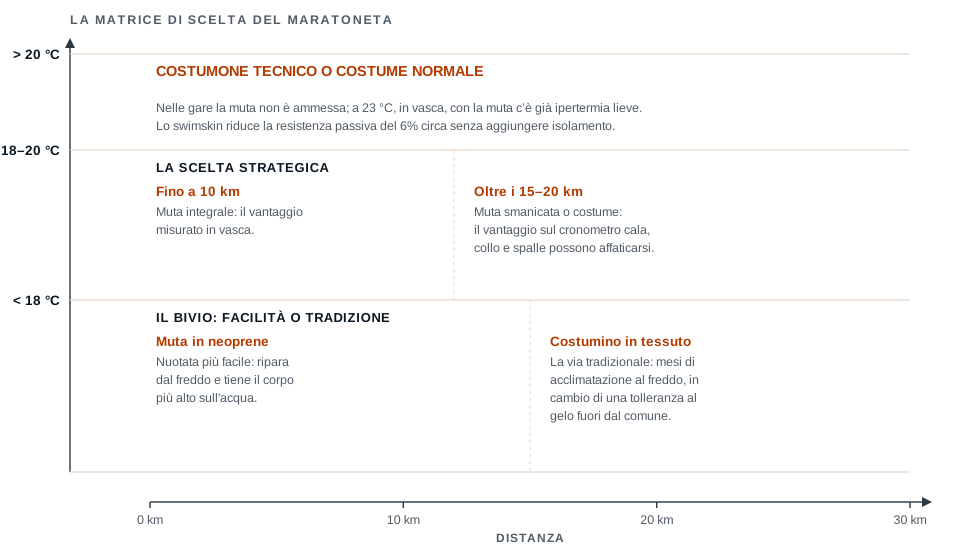
If you follow the mystical philosophy of Traditional Marathon Swimming as strictly as a Mandalorian follows the Way, then you are condemned to a textile swimsuit even below 18 °C (64 °F). You will suffer from the cold during long months of acclimatization, but you will develop an extraordinary tolerance to freezing temperatures, which will allow you to walk around in a T-shirt in January (wherever you are) and will give you the chance to tell people you swim in a swimsuit even in winter (making you look like a reckless exhibitionist). This is the way. For everyone else:
- In cold water (below 18 °C (64 °F)), a wetsuit makes the swim much more accessible: it reduces the cold you have to endure, lowers energy expenditure, and in pool tests, it makes you faster, all the more so the slower you are.
- Over longer distances: Buoyancy and protection from the cold remain, but in the long run, the advantage tends to diminish. It is possible that you may pay for it with neck and shoulder strain that remains to be measured. If you do not want to give it up, train with the wetsuit to get used to it, or consider a sleeveless model.
- In warm water: above 20 °C (68 °F) in races, a wetsuit is not allowed, and already at 23 °C (73 °F) in the pool, mild hyperthermia has been measured with a wetsuit. A textile swimskin does not add insulation and reduces passive drag by 5–6%: in the pool, on the stopwatch, it is worth between 1.5 and 3%. This is unless you are a swimsuit Mandalorian, in which case you will give up a couple of seconds per 100 for your noble obsession.
Scientific bibliography
- Baldassarre, Bonifazi, Zamparo & Piacentini (2017). Characteristics and Challenges of Open-Water Swimming Performance: A Review. Int J Sports Physiol Perform, 12(10), 1275–1284.
- Burke, Hawley, Wong & Jeukendrup (2011). Carbohydrates for training and competition. J Sports Sci, 29(sup1), S17–S27.
- Button, Croft, Graham, Cotter & Lucas (2013). A multifactorial examination of human response to sudden cold-water immersion. In Cotter, Lucas & Mündel (eds.), Environmental Ergonomics XV, pp. 58–60 (conference abstract). ISBN 978-0-473-22821-7.
- Capelli, Zamparo, Cigalotto, Francescato, Soule, Termin, Pendergast & di Prampero (1995). Bioenergetics and biomechanics of front crawl swimming. J Appl Physiol, 78(2), 674–679.
- Chamberlain, Marshall & Keeler (2019). Open Water Swimming: Medical and Water Quality Considerations. Curr Sports Med Rep, 18(4), 121–128.
- Chatard, Senegas, Selles, Dreanot & Geyssant (1995). Wet suit effect: a comparison between competitive swimmers and triathletes. Med Sci Sports Exerc, 27(4), 580–586.
- Chatard & Wilson (2008). Effect of Fastskin Suits on Performance, Drag, and Energy Cost of Swimming. Med Sci Sports Exerc, 40(6), 1149–1154.
- Conceição, Marinho, Stastny, Gonçalves, Freitas, da Costa-Machado & Louro (2025). Open Water Swimming: Swimmers' Kinematical and Neuromuscular Characterisation in 5 km Swim. Sports, 13(10), 335.
- Cordain & Kopriva (1991). Wetsuits, body density and swimming performance. Br J Sports Med, 25(1), 31–33.
- Cortesi, Fantozzi, Di Michele, Zamparo & Gatta (2014). Passive drag reduction using full-body swimsuits: the role of body position. J Strength Cond Res, 28(11), 3164–3171.
- Cox (2013). Open Water Swimming Manual: An Expert's Survival Guide for Triathletes and Open Water Swimmers. Vintage Books.
- DiGeronimo (2010). Swimming Economy in Long Distance Swimmers and Ironman Triathletes. Master's thesis, The Ohio State University.
- Fernández-Asensio, Rodríguez-Adalia, Hermosilla-Perona, Chaverri & Veiga (2024). Pacing strategies of 10 km elite open water swimmers with enhanced temporal resolution: World Swimming Championships Budapest 2022. J Sports Sci, 42(24), 2333–2342.
- Gay, López-Contreras, Fernandes & Arellano (2020). Is Swimmers' Performance Influenced by Wetsuit Use? Int J Sports Physiol Perform, 15(1), 46–51.
- Gay, Ruiz-Navarro, Cuenca-Fernández, López-Belmonte, Abraldes, Fernandes & Arellano (2022). The Impact of Wetsuit Use on Swimming Performance, Physiology and Biomechanics: A Systematic Review. Physiologia, 2(4), 198–230.
- Gay, Zacca, Abraldes, Morales-Ortíz, López-Contreras, Fernandes & Arellano (2021). Swimming with Swimsuit and Wetsuit at Typical vs. Cold-water Temperatures (26 vs. 18 ℃). Int J Sports Med, 42(14), 1305–1312.
- Hue, Monjo & Riera (2015). Imposed Cold-water Ingestion during Open Water Swimming in Internationally Ranked Swimmers. Int J Sports Med, 36(11), 941–946.
- Hutteau, Bertucci & Lodini (2007). Effet du port d'une combinaison intégrale et d'une trifonction sur la vitesse de nage et l'amplitude du cycle de bras en triathlon. Sci Sports, 22(1), 60–62.
- Kumstát, Rybářová, Thomas & Novotný (2016). Case Study: Competition Nutrition Intakes During the Open Water Swimming Grand Prix Races in Elite Female Swimmer. Int J Sport Nutr Exerc Metab, 26(4), 370–376.
- Lim, Swafford, Conroy & Mercer (2023). Shoulder Muscle Activity While Swimming in Different Wetsuits and Across Different Paces. Int J Exerc Sci, 16(1), 172–181.
- de Lucas, Balikian, Neiva, Greco & Denadai (2000). The effects of wet suits on physiological and biomechanical indices during swimming. J Sci Med Sport, 3(1), 1–8.
- Markey, Galan-Lopez, Esh, Carter, Chrismas, Mountjoy, Constantini & Taylor (2026). Thermoregulatory responses in open water and pool swimming: Presentation of hypothermia and hyperthermia within and outside of World Aquatics water temperature thresholds. J Sci Med Sport, 29(1), 28–41.
- Morales, Tamayo Fajardo & González-García (2019). High-Speed Swimsuits and Their Historical Development in Competitive Swimming. Front Psychol, 10, 2639.
- Nikolaidis, Di Gangi, de Sousa, Valeri, Rosemann & Knechtle (2018). Sex difference in open-water swimming—The Triple Crown of Open Water Swimming 1875-2017. PLoS ONE, 13(8), e0202003.
- Nuckton, Claman, Goldreich, Wendt & Nuckton (2000). Hypothermia and afterdrop following open water swimming: the Alcatraz/San Francisco Swim Study. Am J Emerg Med, 18(6), 703–707.
- Parsons & Day (1986). Do wet suits affect swimming speed? Br J Sports Med, 20(3), 129–131.
- Pavlík, Pupiš & Pavlović (2015). Variability of swimming performance depending on the use of wetsuit. Res Phys Educ Sport Health, 4(2), 51–55.
- Peeling & Landers (2007). The effect of a one-piece competition speedsuit on swimming performance and thermoregulation during a swim-cycle trial in triathletes. J Sci Med Sport, 10(5), 327–333.
- Pugh & Edholm (1955). The physiology of Channel swimmers. Lancet, 266(6893), 761–768.
- Roxburgh, Edgar & Cotter (2026). Prolonged stable hypothermia during a 10-hour cold open-water marathon swim. Exp Physiol, 111(4), 1652–1656.
- Saycell, Lomax, Massey & Tipton (2019). How cold is too cold? Establishing the minimum water temperature limits for marathon swim racing. Br J Sports Med, 53(17), 1078–1084.
- Shaw, Koivisto, Gerrard & Burke (2014). Nutrition Considerations for Open-Water Swimming. Int J Sport Nutr Exerc Metab, 24(4), 373–381.
- Skutnik, Owen, Hite, Sweitzer, Petersen, Johnson, Mickleborough, Stager & Schlader (2026). Safe cold-water thresholds while wearing wetsuits approved for open water swimming competitions. J Appl Physiol, 140(3), 816–824.
- Tipton & Bradford (2014). Moving in extreme environments: open water swimming in cold and warm water. Extrem Physiol Med, 3, 12.
- Tipton, Pandolf, Sawka, Werner & Taylor (2008). Physiological adaptation to hot and cold environments. In Taylor & Groeller (eds.), Physiological Bases of Human Performance During Work and Exercise, pp. 379–400. Churchill Livingstone Elsevier, Edinburgh. ISBN 978-0-443-10271-4.
- Toussaint, Bruinink, Coster, de Looze, van Rossem, van Veenen & de Groot (1989). Effect of a triathlon wet suit on drag during swimming. Med Sci Sports Exerc, 21(3), 325–328.
- Ueberschär, Schleichardt, Buchhop, Fichtner & Moeller (2018). Quantification of improvement in triathlon swimming performance by textile speedsuits. Sports Eng, 21(4), 379–388.
- Ulsamer, Rüst, Rosemann, Lepers & Knechtle (2014). Swimming performances in long distance open-water events with and without wetsuit. BMC Sports Sci Med Rehabil, 6, 20.
- Wakabayashi, Nishimura, Wijayanto, Watanuki & Tochihara (2013). Effect of repeated forearm tissue cooling on non-shivering thermogenesis in hypothermic skeletal muscle in human. In Cotter, Lucas & Mündel (eds.), Environmental Ergonomics XV, p. 197 (conference abstract). ISBN 978-0-473-22821-7.
- Weitkunat, Knechtle, Knechtle, Rüst & Rosemann (2012). Body composition and hydration status changes in male and female open-water swimmers during an ultra-endurance event. J Sports Sci, 30(10), 1003–1013.
- Yanai (2001). Rotational effect of buoyancy in frontcrawl: does it really cause the legs to sink? J Biomech, 34(2), 235–243.
- Yanai & Wilson (2008). How does buoyancy influence front-crawl performance? Exploring the assumptions. Sports Technol, 1(2–3), 89–99.
- Zacca, Mezêncio, de Souza Castro, Nakamura, Pyne, Vilas-Boas & Fernandes (2022). Case Study: Comparison of Swimsuits and Wetsuits Through Biomechanics and Energetics in Elite Female Open Water Swimmers. Int J Sports Physiol Perform, 17(1), 130–136.
- Zamparo, Bonifazi, Faina, Milan, Sardella, Schena & Capelli (2005). Energy cost of swimming of elite long-distance swimmers. Eur J Appl Physiol, 94(5–6), 697–704.