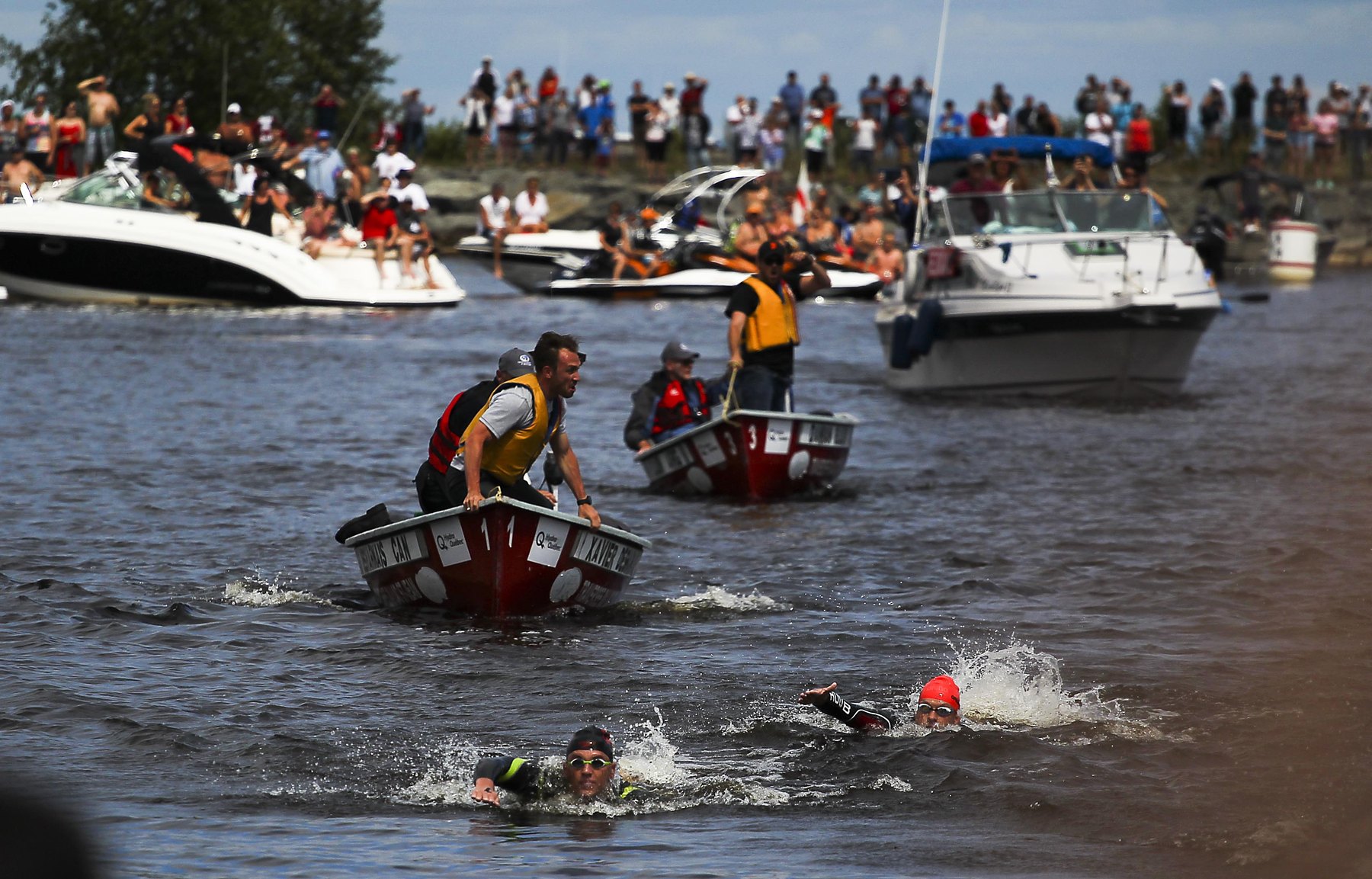
On Tuesday, September 1, 1908, a twenty-one-year-old, Louis Vayre, swam across the canal in Cette — the city would only be spelled Sète from 1928 — in twenty-nine minutes. It is 1,850 meters. The next day, the Petit Méridional, the newspaper that invented the race together with the Olympique de Cette, published the report with the winner's name. It is the first written record of a crossing that the club's memory traces back to 1900 and which reached its 105th edition in 2026.
Heraclitus said that you cannot step into the same river twice. But you can swim in the same race. Swimming has taken place in Sète since 1908. As far as we know, it is the oldest open water race still on the calendar.
At Omniathlon, we call these races monuments. They are crossings founded by 1975 that are still active. Their first edition is documented by period newspapers, club archives, or local chronicles. In total, there are forty-two, in thirteen countries, ordered by their year of origin. This article selects about twenty of them. They are not necessarily the oldest in absolute terms, but those with a story to tell and a location worth the trip.
Ports, festivals, and a cannon shot
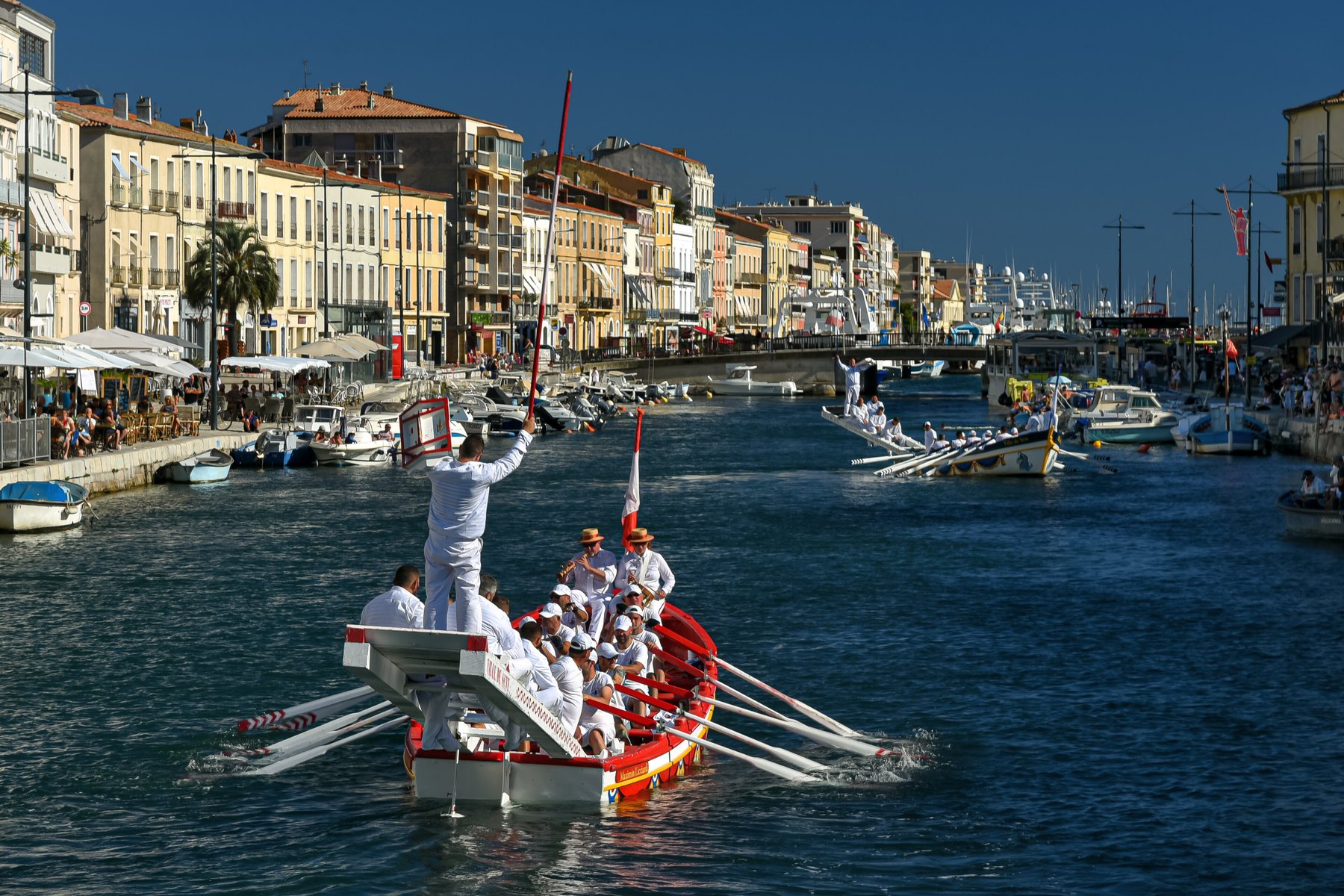
In Sète, you swim in the Canal Royal, between the sea and the Étang de Thau. The current decides the direction. When the water enters from the sea, you start from the Môle Saint-Louis towards the Sadi-Carnot bridge. The race takes place during the Saint-Louis festival.
The port was inaugurated in 1666. Since then, the canal has hosted water jousting. Two boats are pushed by eight or ten rowers. Two men stand on a platform two meters above the water with a lance and a shield. One of the two ends up in the water.
Women entered the race in 1922. There were six of them alongside thirty men. Between 1950 and 1970, the big names of French swimming won — Alfred Nakache, Alex Jany, Jean Boiteux. Boiteux was the Olympic champion in the 400m in Helsinki.
Above the port, on the side of Mont Saint-Clair, lies the Marine Cemetery. It is the cemetery of Paul Valéry's poetry. The poet was born in Sète and is buried there.
In Spain, the oldest race is swum in Tarragona. The Reial Club Nàutic, founded in 1878, organized the first port crossing in 1925. It is the oldest still on the calendar in Spain. Today it is held in September, for the Santa Tecla festival.
A year later, the Club Natació Atlètic did the same in Barcelona, for La Mercè. Ramon Artigas won the first edition. The second went to August Heitmann, a German who took the race's name outside of Catalonia. Artigas then won five times in a row, from 1928 to 1932.
In a century, it has stopped only twice: in 1937 and 1938 due to the Civil War, and during the pandemic. The start has moved from the Portal de la Pau to the Moll de Bosch i Alsina. The port is the same.
On the Atlantic, in Gijón, in 1916 five swimmers lowered themselves from a boat into the port of El Musel. Spain was neutral in the World War. A German won, Robert Salomón, a Siemens delegate in Asturias. Today, they swim 4,500 meters with start and finish at the marina.
In San Sebastián, the Paseo Nuevo crossing has changed its name in every era. It was called del Príncipe in 1930, de la República in 1931. Then it took other names, with a break for the Civil War.
In Ceuta, swimming has taken place since 1943. Every August 5, for the Virgen de África, the start in the port is at the noon cannon shot. The organizing club was founded three years after the first edition.
The year of Ederle
On August 6, 1926, Gertrude Ederle swam across the English Channel. She came from New York, was twenty years old, and touched land in fourteen and a half hours. She was the first woman to complete the route. She lowered the men's record held by Enrique Tirabocchi — 16h33' — by almost two hours. President Coolidge called her "America's best girl". In those same months, two races still on the calendar were born. One is Barcelona. The year after, a third one arrived.
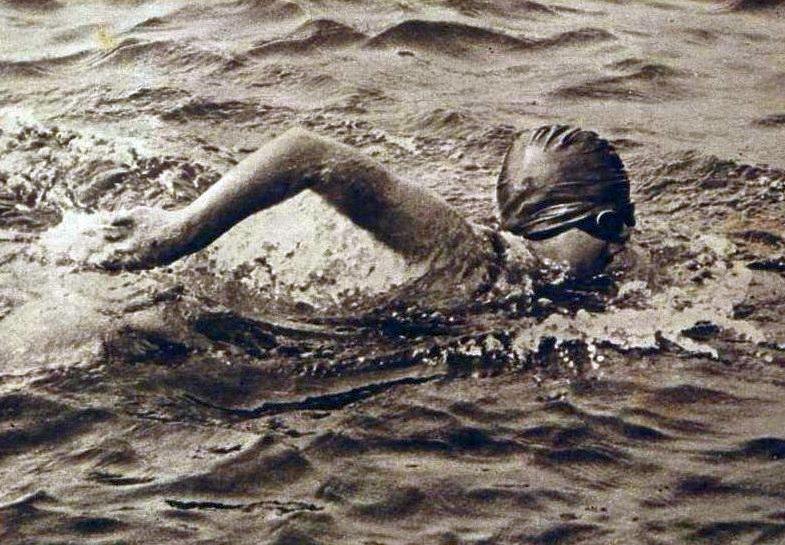
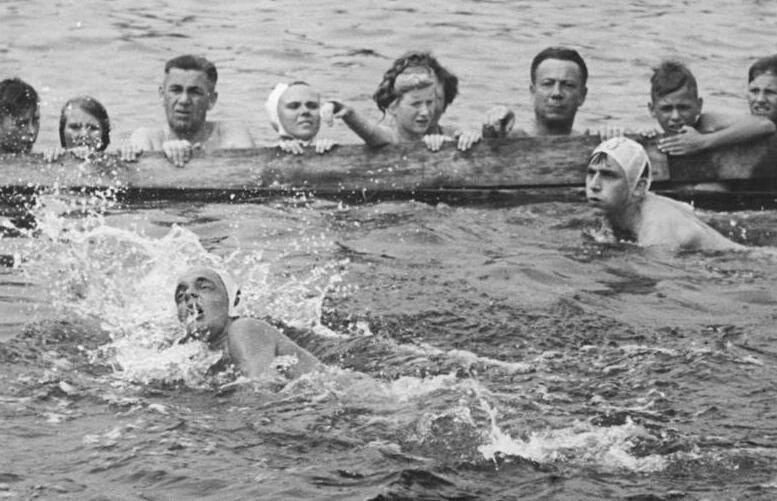
In Stralsund, on the Baltic, the Strelasund separates the island of Rügen from the mainland. Reports from 1825 say that two Prussian officers and a civilian swam across it. In 1837, six people tried from Stralsund towards Altefähr. Three arrived after an hour and a half, and the escort boats picked up the others. The first race was in 1926, won by Franz Wegner and Emmi Gronemann — a women's classification from the very beginning.
The war stopped the crossing only in 1940. In the fifties, the race lost its audience and stopped again, until in 1965 the GDR water rescue service revived it. Since 1990, the DLRG of Stralsund has organized it. Today, 2,315 meters are swum from Altefähr to the seaside resort of the Hanseatic city, with 1,070 spots available for safety reasons. In Stralsund, there is the Marienkirche, whose tower was the tallest building in the world between 1549 and 1647.
The Sundschwimmen profile on Omniathlon 2,315 meters on the first Saturday of July, 1,070 spots.On Long Island, five swimmers crossed the Great South Bay in 1927. The American crossing was born the year after the feat in the English Channel. "We can thank Gertrude Ederle for our race," writes the official website.
The Cross Bay Swim is still swum today across the same bay. The course measures 5.6 miles — nine kilometers — from the Fire Island lighthouse to Brightwaters. The entries have a strict limit. Since 1999, the race has borne the name of Maggie Fischer. She was a seventeen-year-old lifeguard from Brightwaters. 2026 was its hundredth year.
Napoleon's canal and the day of the Assumption
A thousand kilometers separate the two oldest races in the catalog after Sète. Both were born in 1910.
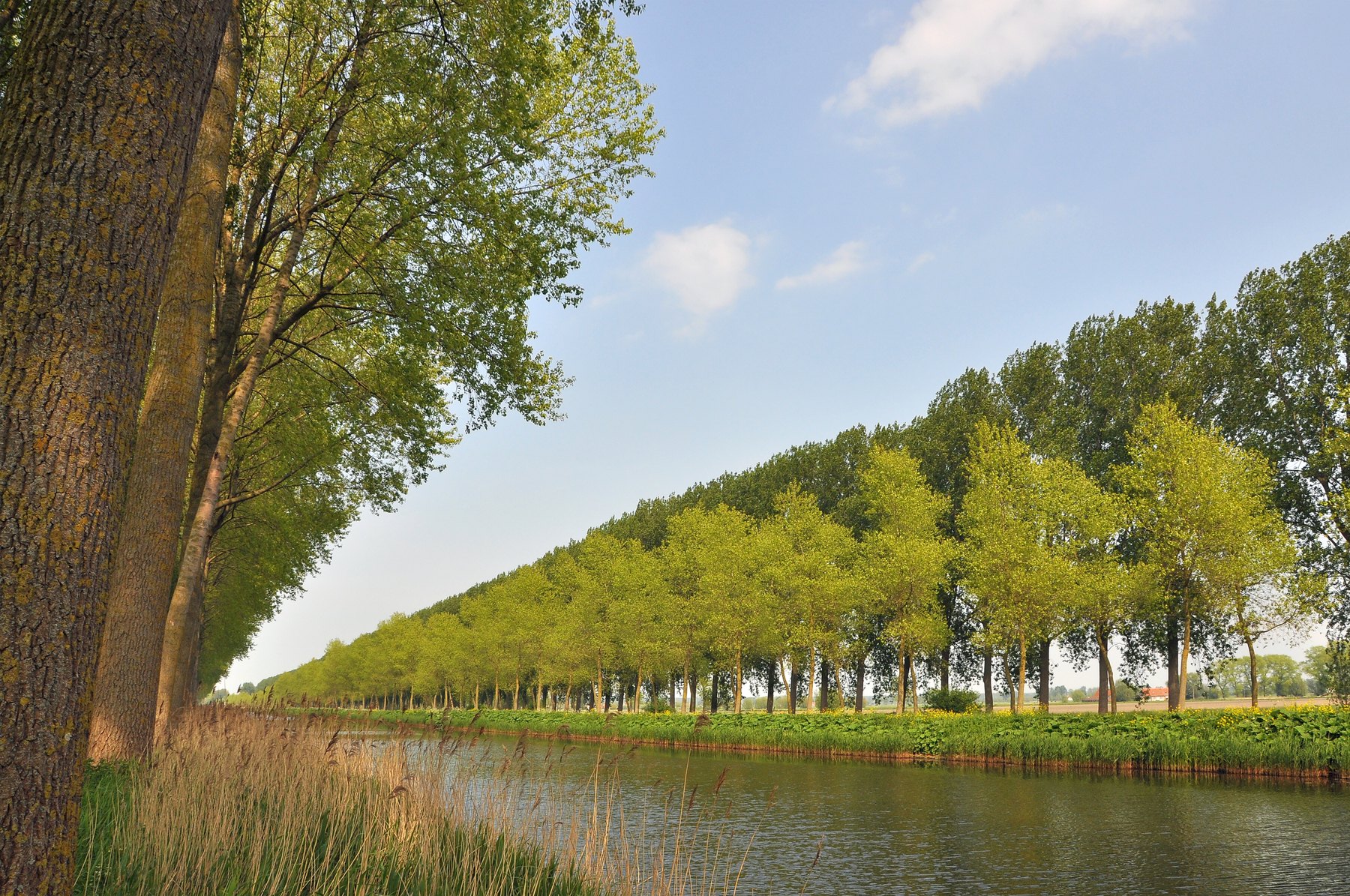
In Bruges, you swim in the Damse Vaart. It is the canal that Napoleon had dug in 1810. The goal was to move troops along the coast without exposing them to the English fleet. At the fall of the Empire, in 1814, only a quarter of it had been dug. It opened to traffic in 1856, when it was already serving other purposes.
The first swim was in 1910. Thirteen people started from the Damme pier towards the Bruges "bridge." Jef Pletinckx, of the CN Bruxelles, won the 4,060 meters in 1h20'. The Koninklijke Brugse Zwemkring organized the race for a century, with some interruptions.
The hundredth edition was scheduled for June 27 and 28, 2026. It was also valid as a Belgian championship. Blue-green algae in the canal caused its cancellation. The hundredth remains to be swum.
On the Adriatic, in the same year, the Šilo–Crikvenica marathon was born. It measures 3,500 meters in the Vinodol Channel, from the island of Krk to the coast. The island was Austro-Hungarian. From 1905, the steamboat Dinko Vitezić connected Šilo to the mainland. The race follows this route.
A poster from August 15, 1912 documents a swimming race in Crikvenica. The date remains the same. It is swum on the day of the Assumption, the patron saint of Crikvenica. Only wars, world and local, have stopped it. The route is unchanged. In 2026, there were nearly four hundred entries from fourteen countries.
Rivers, in January and July
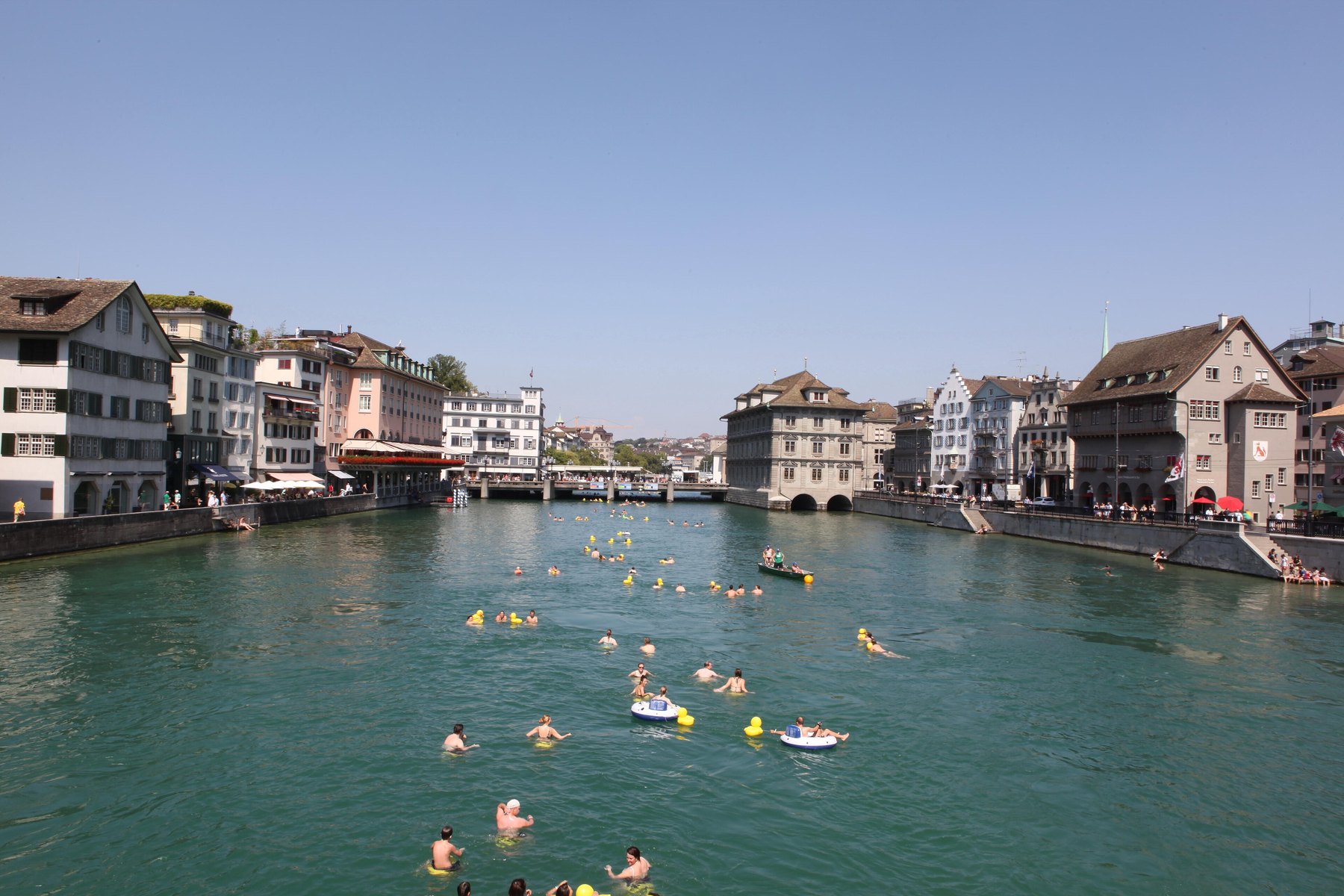
In 1945, two members of the Zürileu club, Noldi Schenk and Ernst Kuster, launched a race in the Limmat. It was swum through the center of Zurich. The event disappeared in the fifties. The entrepreneur Benjamin T. Dall'O revived it in 1959. It stopped again upon his retirement in 1978. It restarted in 1997 with the motto "back to the roots."
Today the cap is set at 4,500 entries — the scorching summer of 2003 brought 4,200. You swim for two kilometers from the Frauenbad Stadthausquai to the Oberer Letten river bath. Since 2013, two categories swim with their clothes inside a dry bag that floats at their side. Just like people going to work.
In 1950, Einar Anselius and Mats Qvarfot wanted to swim under the six bridges of Vansbro, in Sweden. From that idea, the Vansbrosimningen was born. The first time, ten started and nine finished. The course has not changed. You swim two thousand meters with the current in the Vanån river. Then you swim just under a thousand against the current in the Västerdalälven.
At the finish in 1960, Stig Eriksson climbed into a cauldron of hot water over a fire because of the cold. He earned the nickname "Grytan" — the pot. Since 1971, the crossing has been part of En Svensk Klassiker, a challenge of four events in twelve months. It is added to the Vasaloppet, ninety kilometers of cross-country skiing. Then there are the Vätternrundan — three hundred and fifteen by bicycle — and the Lidingöloppet, thirty of running. In 2014, there were 15,976 entries. Today the week of races moves more than ten thousand people.
In Neuburg an der Donau, in Bavaria, in 1970 eight rescuers from the Wasserwacht challenged each other in the Danube in winter. The game has become the largest winter swim in Europe, on the last Saturday of January. It is four kilometers from the Bittenbrunn dam, in front of the Renaissance center, to the rowing club. You go down in a wetsuit, many in carnival costumes, some towing rafts. The start is a volley of firecrackers from the Böllerschützen. The toughest ones swim the last four hundred meters in costume. In 2017, there were 2,259 swimmers.
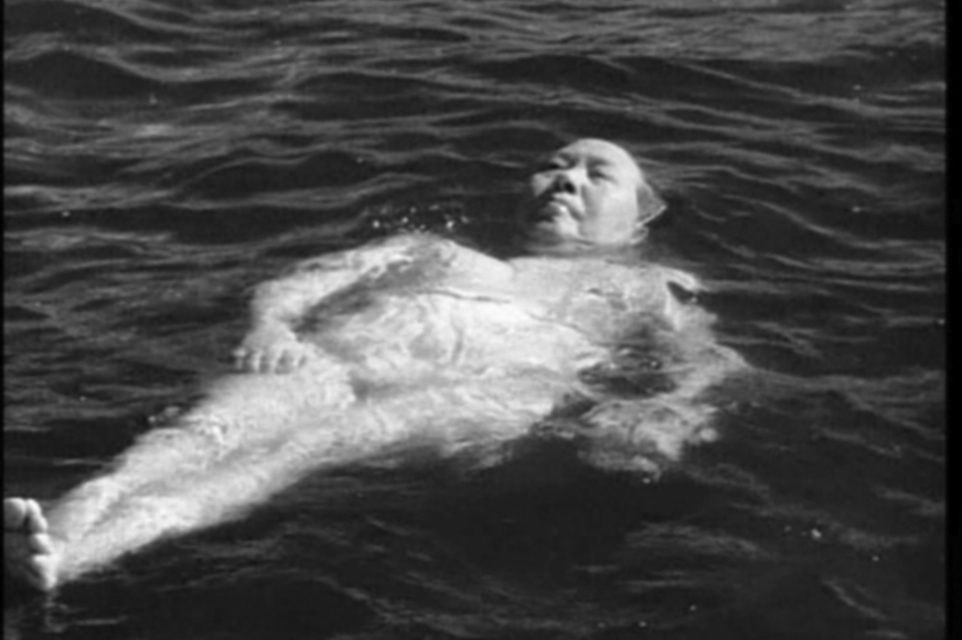
The Yangtze is the largest river. In Wuhan, the water is 1.7 kilometers wide. The first race started on September 9, 1934 from the Hanyangmen pier, in Wuchang, and arrived at the Sanbei pier, in Hankou. Five kilometers, forty-four starters and forty finishers, with one hundred and thirty thousand people on the two banks. It was organized by Zhang Xueliang, who presented the winner Ju Huaqiang with a silver shield. Mao Zedong swam here in 1956, in 1958, and on July 16, 1966. At seventy-two, he spent sixty-five minutes in the water, for fifteen kilometers carried by the current.
Today the festival is held every July 16 in memory of that swim. It stopped only once for a long time: after the crossing on August 31, 1996, the river demanded the men for the floods, and the race was skipped four years in a row. It returned in 2001.
The long ones
Three monument races appear in the ranking of the longest in the catalog. They are the events from ten kilometers and up.
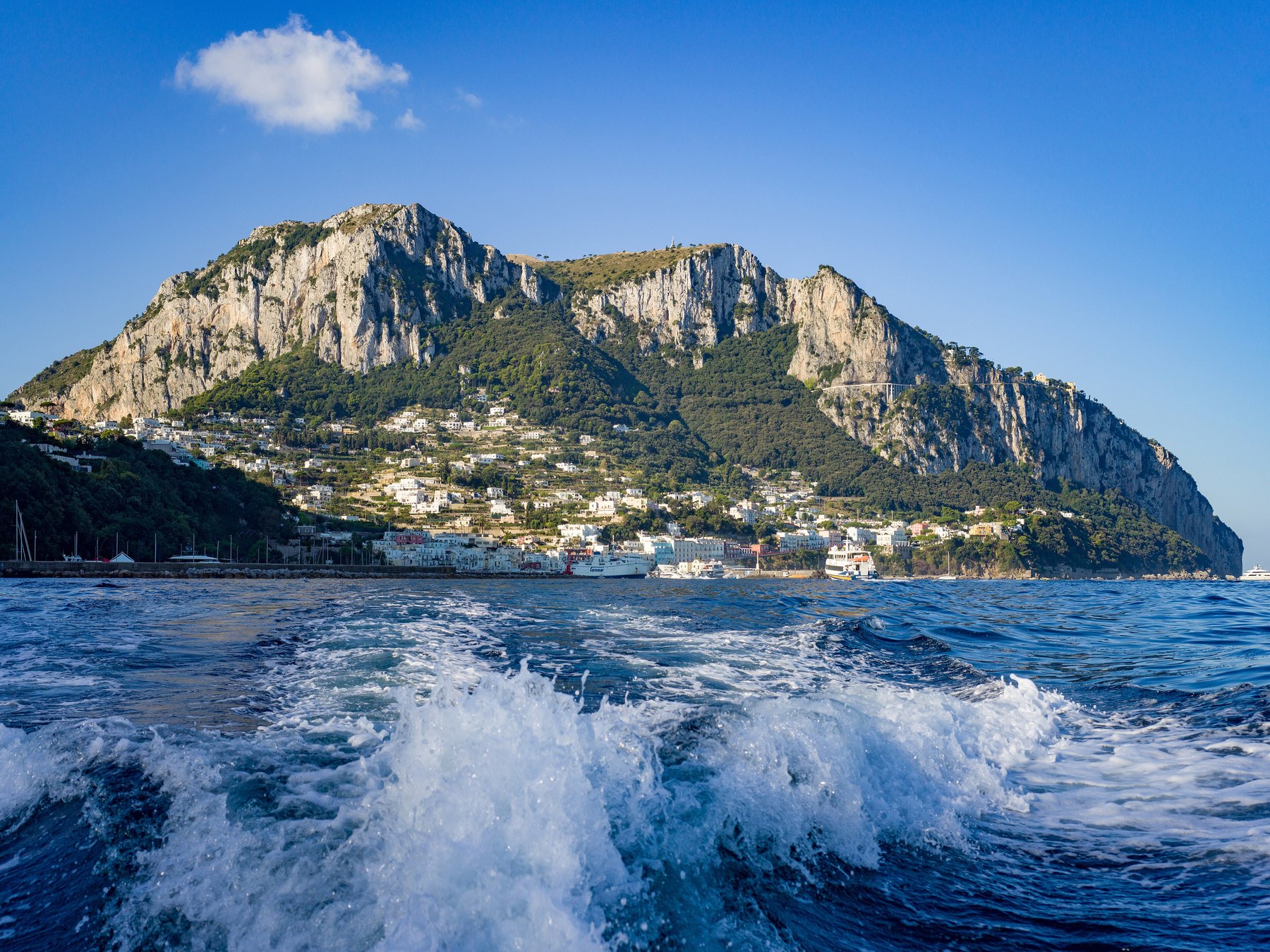
On August 1, 1954, the Capri-Napoli started from Marina Grande. The finish line was the Rotonda Diaz, on the seafront. Ten men swam for thirty-six kilometers. The Egyptian Marei Hassan won in ten hours. Il Mattino promoted the race with Alberto Barone and Lello Barbuto. The event was part of the Motorboat Week.
Until 1992, the event awarded the world title in the specialty in a single race. Giulio Travaglio won it five times. After ten years of silence, from 1993 to 2002, the race resumed in 2003. In 2020, the lowest times in history were recorded. They are the 6h05'07" by Marcel Schouten and 6h04'26" by Arianna Bridi. The women's record is forty-one seconds under the men's one.
A month later, on September 5, 1954, Enzo Acri and Mario Santoro put the first Strait of Messina Crossing into the water with the Sporting Club Villa. It is 5.2 kilometers from Punta Faro to Villa San Giovanni. Below is the saddle between Ganzirri and Punta Pezzo. The seabed rises to 80-120 meters and the tidal currents exceed two meters per second. Scylla and Charybdis are the names of these whirlpools.
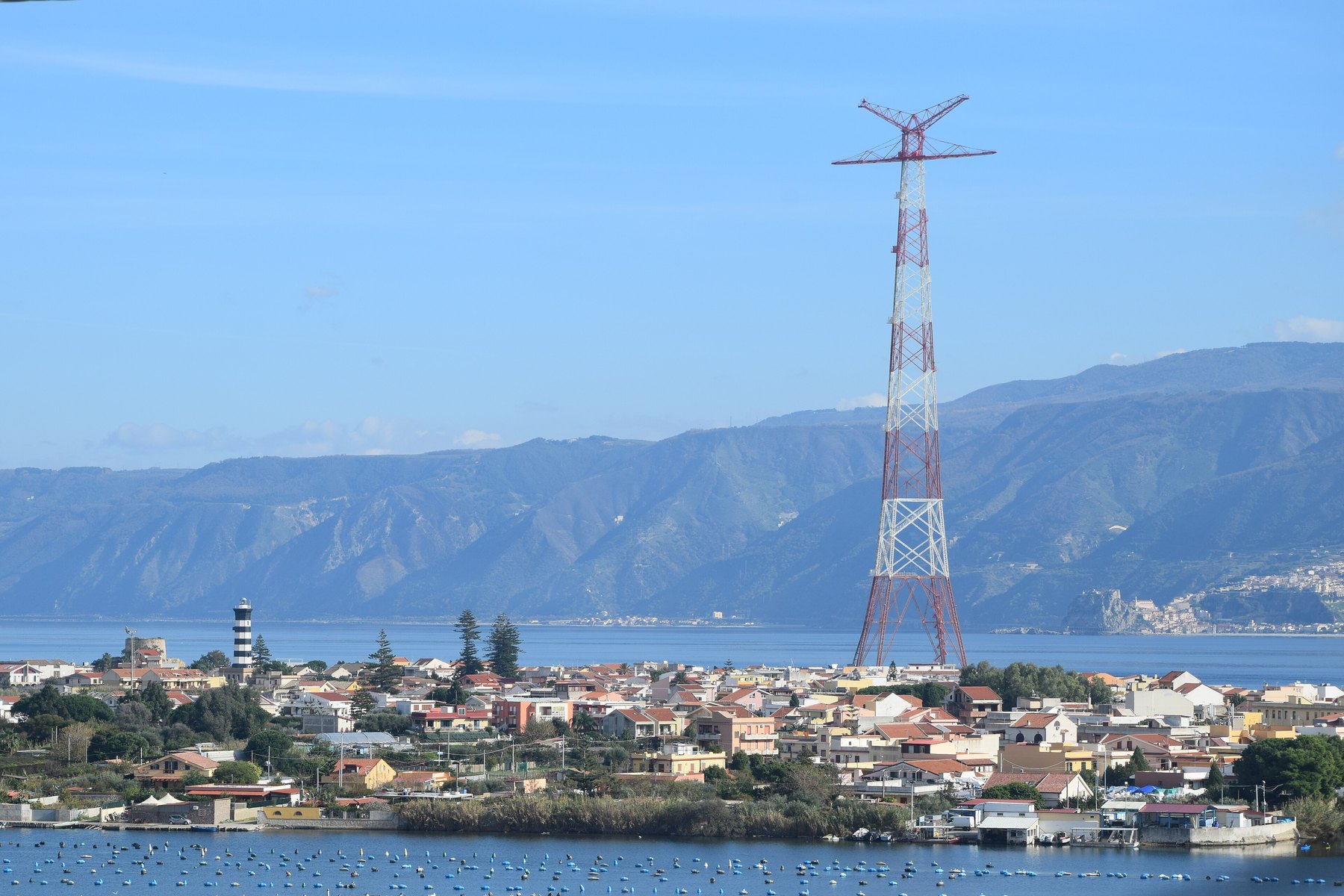
Between the end of the sixties and the beginning of the seventies, national restrictions on long-distance swimming stopped the race. From 1975 to 2005, it was swum with fins. Since 2006, the Centro Nuoto Villa has returned to pure swimming, keeping the numbering from 1954. In 2026 it was the sixty-second. The reference point in the water is the Torre Faro pylon, inaugurated in 1956, which has not carried cables since 1992.
In Quebec, Lac Saint-Jean has a history born from an ice cream. Martin Bédard lived in Roberval, swam, and watched the water. On July 23, 1955, seven swimmers started from Vauvert to cross the lake. Only Jacques Amyot, from Quebec, arrived. He swam twenty-six kilometers in 11 hours, 32 minutes, and 10 seconds, amidst waves, wind, and storms. Once out of the water, he asked for an ice cream. The following year he became the first French Canadian to cross the English Channel.
In 1958, Greta Andersen won the race ahead of the men. John Kinsella — "the human torpedo" — arrived first six times in a row from 1974 to 1979. His record of 7h01'15" stood for twenty-one years. In 1984, Christine Cossette completed the round trip. She swam sixty-four kilometers in 18h27'10". The race maintained that distance from 1985 to 1989.
Since 1999, the Traversée internationale du lac St-Jean has measured thirty-two kilometers in a straight line from Péribonka to Roberval. In 2010 it hosted the World Championships. The Bulgarian Petar Stoychev won eleven times in a row, from 2001 to 2011. In 2026, the seventy-second edition was held. The town has built an entire week of events around it.
The Traversée du lac St-Jean profile on Omniathlon 32 kilometers, the last Saturday of July.The third race is Greek. It has been swum in the Toroneos Gulf since 1971. It is twenty-six kilometers between two fingers of the Chalcidice peninsula. At the start, there are about twenty people. On the beach of Nikiti, an entire town awaits them.
A plaque and three friends without gas
Some monument races are born from a misunderstanding. The Coppa Byron takes its name from a swim that never happened. Legend has it that Byron crossed the Gulf of La Spezia, from Portovenere to San Terenzo, to visit the Shelleys. It all starts from a plaque walled into the Portovenere cave in 1877. Half a century had passed since that single passage of the poet in 1822.
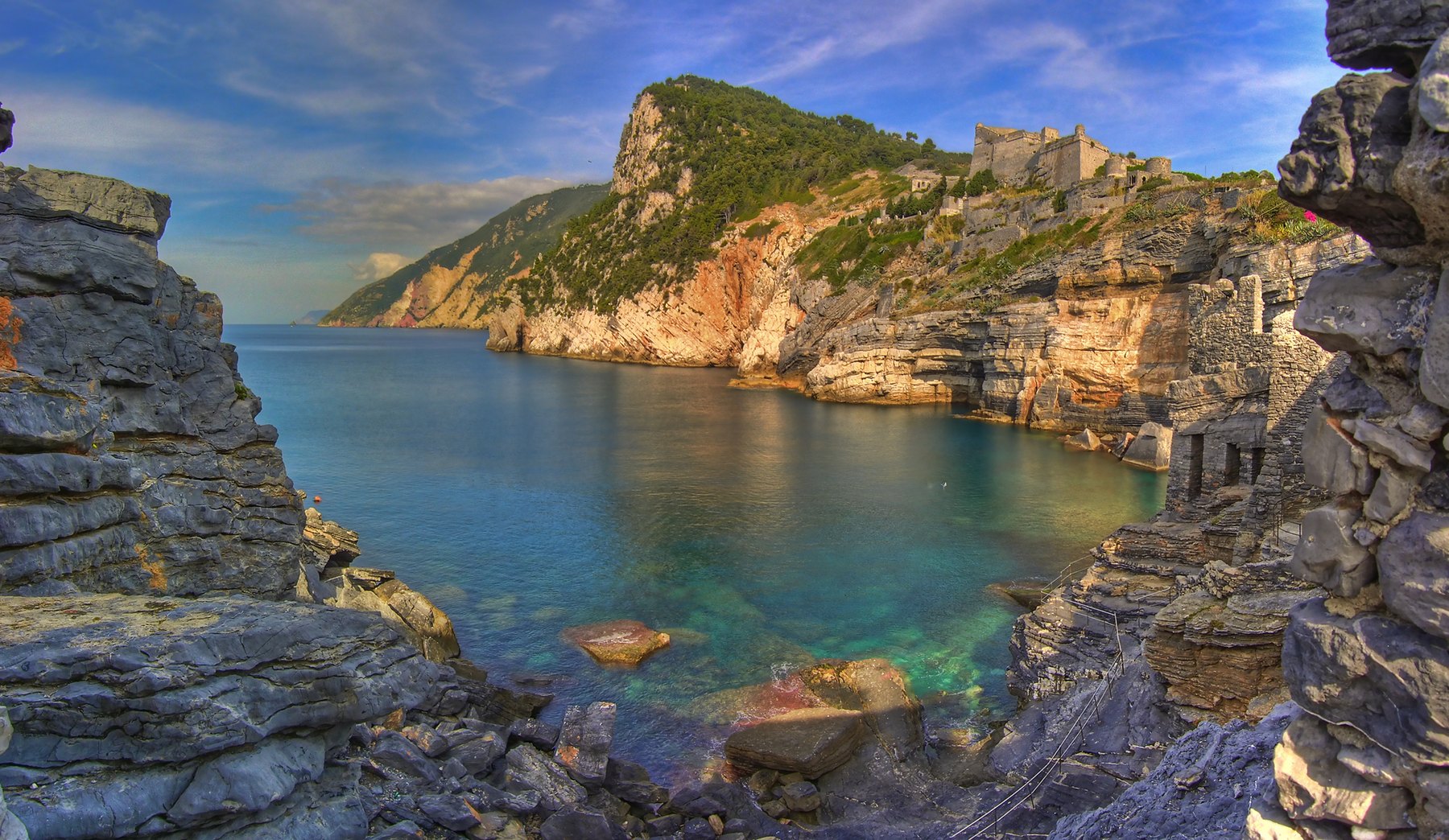
The race in the water is real. The engineer Gio Batta Bibolini, president of the Lerici Pallanuoto, put it on the calendar in 1949. It was swum for four editions, until 1955. Then the event stopped, only to restart in 1986. Today, Lerici Sport traces the route every summer: 7.2 kilometers from Portovenere to the Hotel Shelley, in the gulf that Sem Benelli christened the Gulf of Poets on August 30, 1910.
In 1973, three friends skipped the Buffalo Mile in East London due to gas restrictions. Mike Arbuthnot, Dick Park, and Brian Glover decided to swim a mile at home. They chose the Midmar Dam, near Howick, on the KwaZulu-Natal highlands. Thus the Midmar Mile, in South Africa, was born. It is the youngest monument on the list and the one with the most people in the water.
The first was swum on February 10, 1974. 153 people registered, the youngest was ten years old, and Trevor Strydom won. In 2009, the Guinness World Records recorded the record for open water with 13,755 finishers. The starts take place in heats spread over two days. Howick is located at 1,050 meters above sea level. When it snows on the nearby Drakensberg, a dry cold descends on the city.
Banyoles, Lugano, San Sebastián, and the return to Sète
The entire list is longer than this article. In Lake Banyoles, where rowing took place at the 1992 Olympics, about two thousand people have swum 2,115 meters since September 17, 1944. The Lake Lugano crossing was born in 1932 and winds for 2,500 meters from Caprino to the Lido, with a 250-meter event for children accompanied by an adult. In San Sebastián, the Kontxa has measured 2,220 meters in the bay since 1943 and closes the Gipuzkoa crossing league. They are all collected in the collection, with the year of birth, the next date, and a line of history.
In Sète, on August 24, 2026, the crossing reached its 105th edition. The current distances are 1,000 and 2,500 meters. You start from the Cadre Royal and the direction is decided by the canal's current. In 1908, Louis Vayre took twenty-nine minutes.
All monument races on Omniathlon forty-two races in thirteen countries, with year and next edition.